Next: Normal Matrix Up: Diagonalization of Matrix Previous: Diagonalization of Matrix Contents Index
 and
and  are similar. Then their characteristic polynomials are the same and so are the eigenvalues.
Proof
 |
 |
 |
|
|
 |
A matrix is called diagonalizable if there exists  so that
  is diagnal matrix.
 -square matrix , the following conditions are equivalent.
 is diagonalizable.
 has independent eigenvalues.
 Let the eigenvalues of be
 and corresponding eigenspaces be
 . Then,

Proof

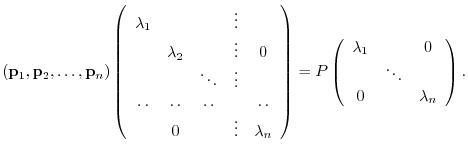
Let be a regular matrix so that is diagonal. Then
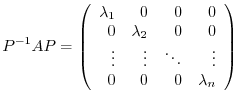
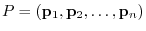 from the left. Then


 are eigenvalues of and
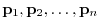 are corresponding eigenvectors. Also, is regular. By the theorem2.5,
are linearly independent.
are corresponding eigenvectors. Also, is regular. By the theorem2.5,
are linearly independent.

 is direct sum. To do so, we need to show by (Exercise4.1)

 be
be
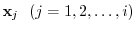


 ,
,
 and
and
 , Thus,
 |
|||
|
 |
 . Hence,


 be a linearly independent vectors in



 . Then
 |
|
 |
|
|
 |
is diagonal.

From this theoerm, if is diagonalizable, then the diagonal elements of are eigenvalues and the number is the same as the dimension of the eigenspace.,
Answer
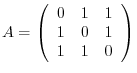
By the example3.2, the eigenvalue of are
 and the eigenspace is
 with its columns are eigenvectors,

A necessary and sufficient condition for which the square matrix is diagonalizable is the dimension of eigenapsce and the multiplicity of eigenvalues are the same.
 Triangular Matrix
Given a square matrix , if we can find a regular matrix so that is an upper triangular matrix, then is called a triangular by .
For -square matrix
 ,
,
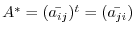 is called a conjugate transpose of . Also, the matrix satisfies
  is caleed a Hermitian matrix. For is real matrix,
  is the same as
  and Hermitian matrix is the same as the symmetric matrix.
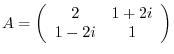 , find .
Answer
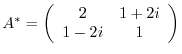 . Then is a Hermitian matrix.
If
 for some -square complex matrix
  , then is calle a unitary matrix. If
 for some -square real matrix , then is called a orthogonal matrix. From this for if is a unitary matrix, then
 and if is a orthogonal matrix, then
 .
.
-square matrix be
. Then can be transformed to the upper traiangular matrix by siutable unitary matrix .
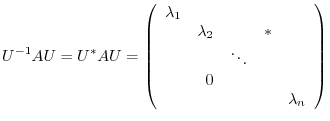
Proof
We use mathematical induction on the degree of .
For  ,
,
 it self is an upper triangular. Assume that true for
  -square matrix. Then show the theorem is true for -square matrix.
Let
 be an eigenvalue of and
 be th corresponding eigenvector. Now choose unit vectors
,
be th corresponding eigenvector. Now choose unit vectors
,
 ,
,  ,
,
 を
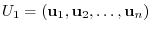
を  to be the basis of the orthonormal system. Then by Exercise4.1,
 |
|
 |
|
|
 |
||
|
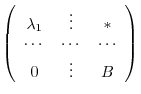 |
is -square matrix. By the theorem 4.1, and  have the same eigenvalues, Eigenvalues of are eigenvalues
 of except
. By assumption, for -square matrix , there exists -square unitary matrix
of except
. By assumption, for -square matrix , there exists -square unitary matrix  such that
 is upper traiangluar matrix.
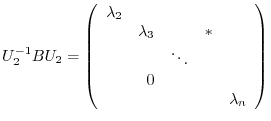
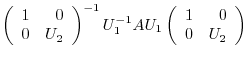
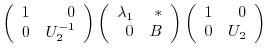
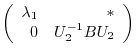
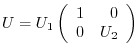 . Then is unitary and
 |
|
 |
|
|
 |
||
|
 |
||
|
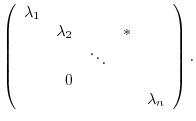 |
is an upper traiangular matrix.
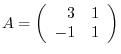 is diagonalizable. If not, traiangulate.
Answer
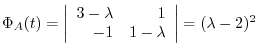 implies that the eigenvalue is
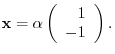
  . Also,

 and
and
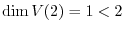 . Thus,by the theorem4.1, it is impossible to diagonalize. So, we will try to get an upper traiangular matrix.
From the eigenvector
 , we obtain the unit eigenvector
 . Now using the Gram-Schmidt orthonormalization, we create the orthonormal basis
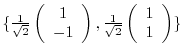 . Let
. Let
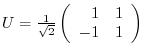 . Then is orthogonal matrix and
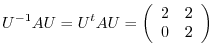
-square matrix has distince real eigenvalues. Then there exists an orthogonal matrix so that is an upper triangular matrix.
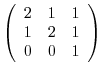
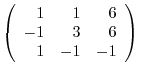
1. Determine whether the following matices are diagonalizable. If so find a regular matrix and diagonalize. If not, find an upper triangluar matrix.
2. Suppose  are subspaces of the vector space
  . Show that
  is a direct sum if and only if
 .
.
3. Let be finite dimensional. Then show the following is true.

4. For 3 dimensional vector space
 , let
, let

 .
.
5. Show the absolute value of the eigenvalue  of an orthogonal matrix is
  .
.
6. Suppose that the column vectors of is orthonormal basis. Then show that is unitary matrix.