Next: Linear Mapping Up: Matrix and Determinant Previous: Matrix Factorization Contents Index
 Cramer's Rule
Before defining the determinant, we consider the system of linear equations with 2 unknowns.
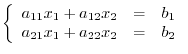
 . Multiply
  to the first equation and multiply
  to the second equation. Then we add these two equations. We have

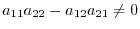 , we have
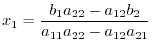
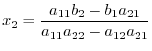
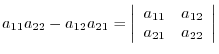
 and denoted by
 or
or
 . Using this notation, we can write
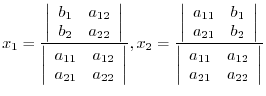
Cofactor Expansions
 be a matrix with the order of
  .
.
 For
For  ,
,

 For
For  ,
,

 For
For  , the determinat of a matrix deleting
  th row and
  th column is called a minor and denoted by
  .
The cofactor of
.
The cofactor of  is define as follows:
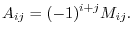
 is defined as follows:
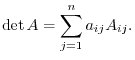
This way of finding the determinant is called a cofactor expansion using the th row. Similarly, the following way of finding the deteminant is called a cofactor expansion using the th column:
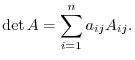
For a square matrix with the order of , there are ways of cofactor expansions using rows. Similarly, there are ways of cofactor expansions using columns. Surprisingly, the result using which row or column is not important. They are all the same.
 , the result of the cofactor expansions is the same.
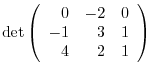
Answer
Using the  st row, apply the cofactor expansion.

Permutation
A one-to-one mapping  of the set
 onto itself is called a permutation. We denote the permutation by

Note that since is one-to-one and onto, the sequence
 is simply a rearrangement of the numbers
 . Note also that the number of such permutations is
  , and that the set of them is usually denoted by
  . We also note that if
 , then the inverse mapping
 ; and if
 , then the composition mapping
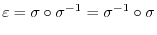
 . In particular, the identity mapping
Determinant
Let
be a square matrix of the order . Then consider a product of elements of such that one and only one element comes from each row and one and only one element comes from each column. Such a product can be written in the form
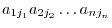
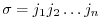 in . Conversely, each permutation in , determines a product of the above form. Thus the matrix contains such products.
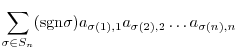
The determinant of the matrix of the order , denoted by
 or
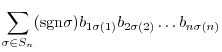
or  , is the following sum which is summed over all permutations
 in :
in :
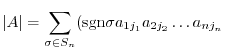
We next explain how to determine
 . We say is even or odd according as to whether there is an even or odd number of pairs
  for which
 , written
by
, written
by
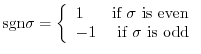
For example, (1432) can be written as

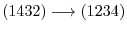
In this case, the number of transpositions is diffetent. But both of them required the odd number of transposition. So, we have
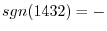
 .
.
Answer

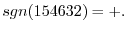

Properties of Determinants
We now list the basic properties of the determinant..
 . Then

Proof
Suppose
 . Then
 where
where
 . Hence
 |
 |
 |
|
 |
 |
 . Then
 , and
, and

 runs through all the elements of ,
runs through all the elementsof . Thus
runs through all the elements of ,
runs through all the elementsof . Thus
 .
.
Proof by cofactor expansion The cofactor expansion of  using the th column is the same as the cofactor expansion of using the th row. Thus,
 .
.
With this theorem, all properties true for the rows are true for columns.
 is a constant multiple
  of . Then
 .
.
Proof
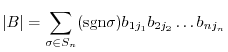
Let
 . Then
 , we have

Alternate proof
Let be the matrix so that the  th row of is multiplied by . Now using the cofactor expansion on the th row, we have,
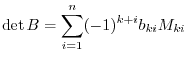
 . Since
  is the same for and , we have

is the matrix obtained by interchangin two rows(columns) of . Then we have
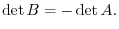
Proof
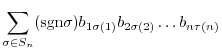
We prove the theorem for the case that two columns are interchanged. Let  be the transposition which interchanges the two numbers corresponding to the two columns of that are interchanged. If
and
be the transposition which interchanges the two numbers corresponding to the two columns of that are interchanged. If
and
 , then
 . Hence, for any permutation ,

 |
|
 |
|
|
 |
Since the transpositoin is an odd permutation,
 . Thus
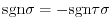 , and so
 runs through all the elements of ,
 also runs through all the elements of . Therefore,
 .
.
is obtained by adding a multiple of a row of . Then
 .
.
Proof
Suppose times the th row is added to the th row of . Then
|
|
 |
|
|
 |
th and th rows are identical, hence the sum is zero. The second sum is the determinant to . Thus,
 .
.
From those  theorems above, the matrix obtained by elementary row operation on is the product of the elementary matrix and .
 , where
  is an elementary matrix.
Proof
For elementary row operation
 ,
,
 interchanging of two rows of ,
 multiplying a row of by a scalar ;
 adding a multiple of a row of to another)
Elementary matrices corresponds to the above, let
adding a multiple of a row of to another)
Elementary matrices corresponds to the above, let
 . Then by the theorems 2.5,2.5,2.5,

 is obtained by applying an elementary operation
  to ,
to ,
 .
.
has any of the following properties, then
 .
has a row of zeros.
has two identical rows.
.
has a row of zeros.
has two identical rows.
Proof
(1) In 2.5, take
 .
.
(2) Let be the matrix obtained by interchanging two rows of . Then by th theorem 2.5,
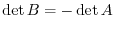 . But the matrix and are the same. Thus,
which implies that
. But the matrix and are the same. Thus,
which implies that
 .
.
(3) Let the th row of be equal to times th row. Then
implies that
. Thus assume that
 . Let be the matrix obtained by multiplying the th row of a matrix . Then by the theorem 2.5, we have
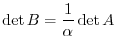 . Also by the theorem 2.5(2),
. Thus,
.
. Also by the theorem 2.5(2),
. Thus,
.

Answer

Here
 means that adding the double of st column to the
  nd column.
t
nd column.
t

Answer
(a)
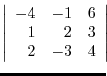 |
 |
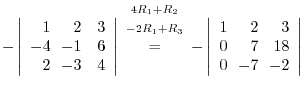 |
|
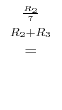 |
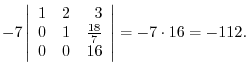 |
is obtained by interchanginf the st row and the rd row of a matrix . Thus by the theorem 2.5, we have


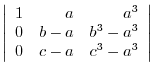
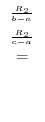
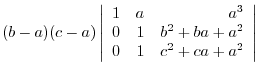
Answer
|
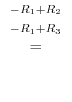 |
 |
|
 |
 |
||
 |
 |
||
|
 |
We introduce two of the most important theorem about the determinant.
Product of determinants

Proof
A matrix can be written by taking a suitable elementary matrix  such that
 . Thus by the theorem 2.5, we have

 . Then
 and some row vector of
  must be zero vector. In other words, some row vector of
  is zero vector. Then
  .
Suppose that
.
Suppose that
 . Then
 . Thus by the theorem 2.3, we have
  . Hence,



is the order . Then the followings are equivalent
 is regular


 exists and
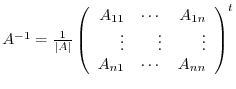 . Here,
  is a cofactor of .

 has a unique solution and the solution is given by the following equation.
![$\displaystyle x_{j} = \frac{1}{\vert A\vert} \left\vert\begin{array}{rrrrr}
a_{...
...{nn}
\end{array}\right \vert = \frac{\vert[A_{j}:{\bf b}]\vert}{\vert A\vert}. $](img957.png)


Before prooving this theorem, the matrix
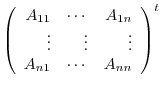 in this theorem is called an ajoint of and denoted by
 .
.
Also, the matrix
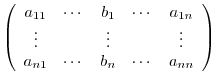 th column of by the
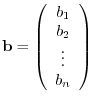 and denoted by
![$[A_{j}:{\bf b}]$](img964.png) .
.
Proof
1)
 2)
2)
Suppose that is regular. Then
 and by the theorem 2.5,
 . Thus
.
. Thus
.
2)
3)
Since
, let
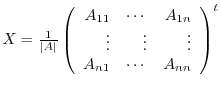 . Then
 |
|
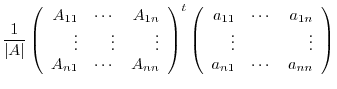 |
|
|
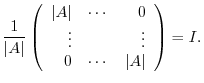 |
 and
and
 .
4)
to the equation
from the left. Then we have
.
4)
to the equation
from the left. Then we have
 |
|
 |
|
|
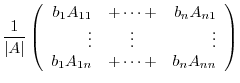 |
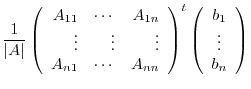
The component
 is the cofactor expansion of
, where
is the cofactor expansion of
, where
![$\displaystyle [A_{j}:{\bf b}] = \left(\begin{array}{rrrrr}
a_{11}&\cdots&b_{1}&...
...vdots&&\vdots&&\vdots\\
a_{n1}&\cdots&b_{n}&\cdots&a_{nn}
\end{array}\right ) $](img978.png)
4)
5)
Suppose that the equation
has the unique solution . Then let the fundamental solution of
 be
be  . By the theorem 2.3, we ahve
 is also a solution of
. Since
is also a solution of
. Since
 , we have
 . Thus by the theorem 2.3, we have
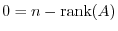 . Hence,
.
. Hence,
.
5)
6), 6)
1) is the theorem 2.3.
We introduce some of the useful idea about finding the determinant. First one is called a Vandermonde determinant.
Suppose some solution of differential euqations is given by
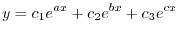
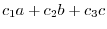
 . Then we have the following system of linear equations:.
 |
|
 |
|
|
|
 |
|
|
|
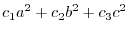 |
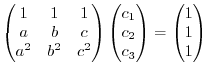
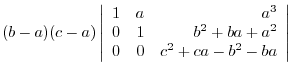
To find the solution of this equation by Cremer's rule, we have the determinant in the denominator. Now we need to find the determinant.
 and called Vandermonde.
Another useful technique is block matrices. Consider a matrix such that
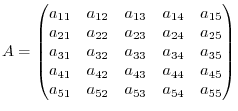
Using a vertical line to cut the matrix at the 3rd and 4th columns. Next using a horizaontal line to cut the matrix at the 4th and 5th row. Then we have

Then we can write the matrix as the following block matrices:
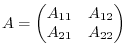
Now consider the matrix  which has block matrices , , and
  , where is
  , is
, is  and is zero matrix. The we have the followings:
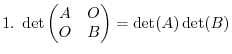 |
|||
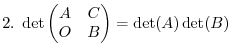 |
Proof Note that
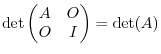 . Note also that、
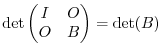 . Now note that

 .
.
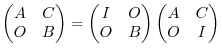
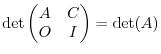
Proof. Let be the square matrix of the order and  be an identiry matrix of the ordr
  . Then let
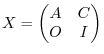 . Then

 and
and
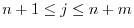 , we have
 . Also for
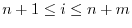 and
, we have
and
, we have
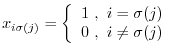


 , where、
 ,
,
 and 、
and 、

 |
|||
 |
|||
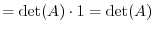 |
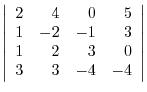
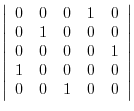
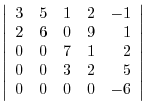
1. Find the determinant of the following matricex:
2. Factor the following matrices:
(a)
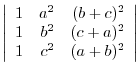 (b)
(b)
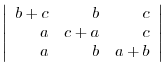 (c)
(c)
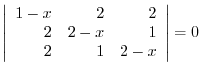
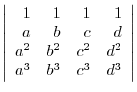 3. Solve the following equations:.
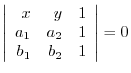
4. Show the equation of the straight line going through two points
 and
and
 is given by
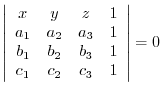
5. Show the equation of the plane going through 3 points
 is given by
6. Suppose that a system of linear equation
has a fundamental solution
 . Then show that .
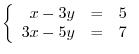
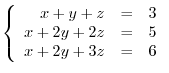
7. Solve the following system of linear equations using Cramer's rule.