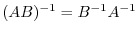
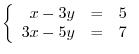
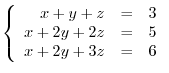
Next: Matrix Factorization Up: Matrix and Determinant Previous: Elementary Row Operation Contents Index
We have introduced Guassian elimination in 2.2. Here we study whether the given system of linear equation has a solution. To start with, we consider the system of linear equation with the unkowns and the number of equations are different.
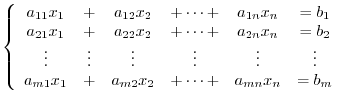
 be a matrix,
![$[A : {\bf b}]$](img676.png) be the augmented matrix,
be the augmented matrix,  be the number of unknowns,
 be the row vectors, and
 be the column vetors of the order
  . Then the system of linear equations is written as
![$\displaystyle A{\mathbf x} = {\bf b} \mbox{または} [A : {\bf b}] $](img679.png)
 and this vector is called solution vector. In general, the following holds.
![$\displaystyle {\rm rank}(A) \leq {\rm rank}([A : {\bf b}]) \leq {\rm rank}(A) + 1 $](img680.png)
 has a solution if and only if
![$\displaystyle {\rm rank}(A) = {\rm rank}([A : {\bf b}]) $](img682.png)
Proof
Let  be a matrix of the form
 . Suppose that
![${\rm rank}(A) = {\rm rank}([A : {\bf b}]) = r$](img683.png) . Then the dimension of the column space of
is
. Then the dimension of the column space of
is  and
and  . Thus,
  st column vectorb of the column space
is a linear combination of
st column vectorb of the column space
is a linear combination of


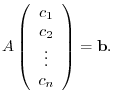
Conversely, think of columns of as column vectors. Thne the equation
can be expressed as

 , then this equation implies that
  is a linear combination of
 and the column space of
are the same. This shows that
and the column space of
are the same. This shows that
![${\rm rank}(A) = {\rm rank}([A : {\bf b}])$](img693.png) .
.

 so that the following equation has a solution.
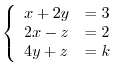
Answer
![$\displaystyle [A: {\bf b}]$](img695.png) |
 |
 |
|
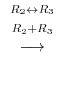 |
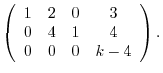 |
![${\rm rank}([A: {\bf b}]) = {\rm rank}A = 2$](img699.png) . Thus
. Thus  must be 0. Therefore
  .
.
 General solution of system of linear equation
 be a pair of solution to the system of linear equations
. Then every solution of
is given by
be a pair of solution to the system of linear equations
. Then every solution of
is given by
 . Here,
  is a solution of
 .
.
Proof
Let  be a solution of
. Then,
be a solution of
. Then,
 is a solution of
since
is a solution of
since

 . Then is a solution of
. Thus, we have
. Then is a solution of
. Thus, we have
 .
.
With this theorem, to solve the system of linear equations
, we first need to solve the homogeneous system
. So, we consider the homogeneous system of linear equations
.
Note that
![${\rm rank}(A) = {\rm rank}([A : {\bf0}])$](img711.png) . Then by the theorem 2.3, a solution exists. In fact,
. Then by the theorem 2.3, a solution exists. In fact,
 is a solution. This solution is called trivial solution. Next Let
  numbers of nontrivial solutions of the system of linear equations be the followings:
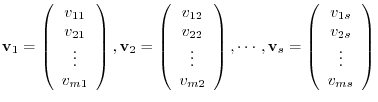

 satisfies
 Thus,
Thus,
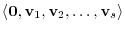 is a subspace. This subspace is called solution space. The basis of this solution space is called an (elementary solution of the system of linear equation
.
is a subspace. This subspace is called solution space. The basis of this solution space is called an (elementary solution of the system of linear equation
.
It is interesting to know the relationship between the dimension of the solution space and the rank of the matrix.
unknowns
. Suppose the rank of the coefficient matrix is , then the fundamental solution is composed of the  solution vectors.
Proof
For
![${\rm rank}(A) = {\rm rank}([A : {\bf0}]) = r$](img720.png) , apply the elementry row operation on
, apply the elementry row operation on
![$[A : {\bf0}]$](img721.png) to obtain the followings:
to obtain the followings:
![$\displaystyle [A : {\bf0}]_{R} = \left(\begin{array}{rrrrrrcr}
1&\cdots&0&d_{1 ...
...ts& &\vdots&\vdots&\vdots\\
0&\cdots&0&0&\cdots&0&\vdots&0
\end{array}\right) $](img722.png)
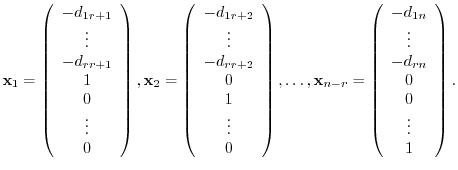
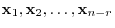 are solution vectors. Also, let

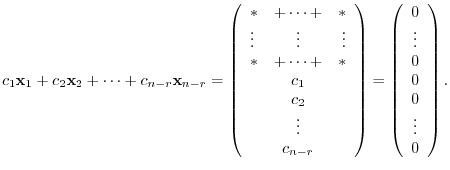
 . Thus,
is linearly independent. Therefore the dimension of the solution space is .
. Thus,
is linearly independent. Therefore the dimension of the solution space is .
Degree of freedom
The number of elementary solutions is called a degree of freedom.
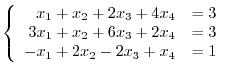
Answer
Apply Gaussian elimination..
|
|
 |
|
 |
![$\displaystyle \left(\begin{array}{rrrrr}
1&0&2&-1&0\\
0&1&0&5&3\\
0&0&0&1&\fr...
...&0&0&\frac{1}{2}\\
0&0&0&1&\frac{1}{2}
\end{array}\right) = [A: {\bf b}]_{R} .$](img731.png) |
![${\rm rank}(A) = {\rm rank}([A : {\bf b}]) = 3$](img732.png) which implies that this system of linear equation has a solution. If we write
which implies that this system of linear equation has a solution. If we write
![$[A:{\bf b}]_{R}$](img733.png) as a system of linear equatios:
as a system of linear equatios:
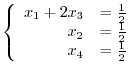
 . Thus the defree of freedom is
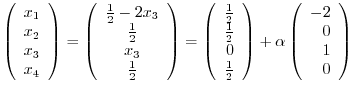
  . Then we let
 and we have the followings:
Inverse Matrix
Consider the matrix
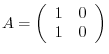 . is not zeor matrix. Now we ask you a question. Do we have a matrix
  so that
 . Unfortunately, the answer is no. In the world of matrices, some nonzero matrix does not have inverse.
Regular Matrix
For the square matrix of the order, if there exists a matrix so that
 , then the matrix is called a regular matrix. The matrix is called an inverse matrix of . Now how many inverse matrices of exist? For example,
 . Then
 . Thus, the inverse matrix of is one. Then we write the inverse matrix of as
  .
.
Using this idea, we solve the system of linear equations
. Let be a regular matrix. Then we have
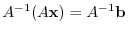 . From this, we have
 . Therefore, to solve the system of linear equations, we can use the inverse matrix . In short, it is enough to find a matrix so that
  We know a quick way to find . Before introducing the technique, we cover the relation between the regular matrix and the rank of the matrix.
is a squre matrix with the order of . Then the followings are equivalent.
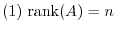
 is regular matrix.
Proof
By theorem 2.2,
 and
and  are equivalent.
In other words, for
, we can choose the product of elementary matrices
are equivalent.
In other words, for
, we can choose the product of elementary matrices  so that
  . Thus, is regular.
Conversely, for is a regular matrix, we can choose a product of elementary matrices so that
 . Note that is the product of elementary matrices. Then is regular. Thus,
  exists. Suppose that
 . Then the entries of the lowest row of
  have to be 0. But then this matrix is not regular. Thus,
.
have to be 0. But then this matrix is not regular. Thus,
.
Now we are ready to introduce how to find a matrix  satisfying . We note that since is regular, for some product of elementary matrices, . So, we multiply this to from the left. Then
 . Thus to find is the same as to find . This shows that if you can get the identiry matrix by applying elementary row operation to , the the same operation on gives rise to .
is regular. If so, find the inverse matrix of where
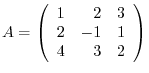 .
.
Answer
![$\displaystyle [A:I]$](img755.png) |
|
 |
|
 |
 |
||
|
![$\displaystyle \left(\begin{array}{rrrrrr}
1&0&0&-\frac{1}{5}&\frac{1}{5}&\frac{...
...
0&0&1&\frac{2}{5}&\frac{1}{5}&-\frac{1}{5}
\end{array}\right ) = [I:A^{-1}] .$](img759.png) |
is regular and
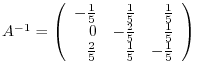 .
.
Summarize what we have studied so far, we have
is the square matrix of the order . Then the followings are equivalent.
 is regular
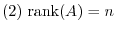

Proof
By theorem 2.2, we have
 . By theorem 2.3, we have
 .
.
1. Solve the following system of linear equations using Gaussian elimination.
2. Determine the value of so that the following system of linear equations has a solution.
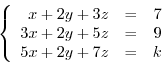
3. Determine whether the following matrix is regular. If so, find the inverse matrix,
(a)
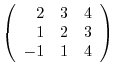
4. Determine the value  so that the following matrix is regular.
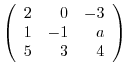
5. Show that the following matrix is regular, and show the following matrix as a product of elementary matrices.
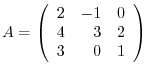 .
.
6. Suppose that all entries of one row of the square matrix are 0. The show that is not regular.
7. Suppose that  are regular matrices of the order . Then show thatthe product of
  is also regular and satisfies