


Next: Jordan Canonical Forms Up: Diagonalization of Matrix Previous: Diagonalization of Matrix Contents Index
In this section, we study the square matrix which is diagonalizable.
Suppose that  -square matrix
  is transposed to a diagonal matrix
 by an unitary matrix
  . Here
  is a diagonal matrix so that
 . Also since
 , we have


 . In other words, The square matrix which is tranposed to diagonal matrix by an unitary matrix satisfies
 . Then we call this matrix normal matrix
Conversely, suppose that is a normal matrix. Then by the theorem 4.1, using the unitary matrix , we have
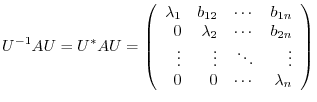
 . Then
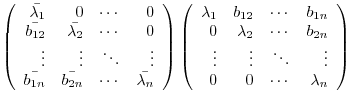
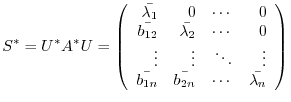 , we have

 |
 |
 |
|
|
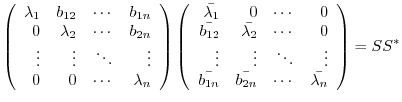 |
Now we check to see the diagonal ecomponents.
Compare the  component.


 component. Using
 , we have


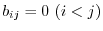 . Thus,
  is a diagonal matrix. Putting together, we have the following theorem.
-square matrix , the following conditions are equivalent.
 is diagonalizable by some unitary matrix .
 is normal.
Now we know that the normal matrix is diagonalizable by an unitary matrix. The normal matrix is a matrix which is commutative of the product of the matrix itself and the conjugate transpose of the matrix. Thus, Hermite matrix, unitary matrix are normal matrix.
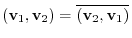
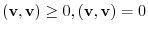
 of the complex vector space
  , if real numbers
 are defined and it has the following properties, then we say
is an inner product of
are defined and it has the following properties, then we say
is an inner product of
 and
and
 .
.
For any vectors
 in a complex vector space and any complex numbers
 , the followings are satisfied.




 and
and
 are equivalent.
Answer
Let be the Hermitian matrix. Then since  , we have
. Thus, is a normal matrix. Next let
, we have
. Thus, is a normal matrix. Next let
 be the eigenvalue of and
  be the eigenvector of corresponding to . Then by the definition4.2,
 |
|
 |
|
|
 |
 . hence, is real number.

From this example, you can see that if is a Hermitial matrix, the diagonanl components of the transposed matrix are real numbers. Furthermore, if is a real square matrix, the following theorem holds.
-square matrix , the following conditions are equivalent.
is an orthogonal matrix and diagonalizable.
is a real symmetric matrix.
 Quadratic Form
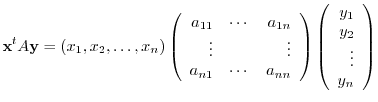
For any -squar real matrix and vectors
 , the expression
 |
|
 |
|
|
 |
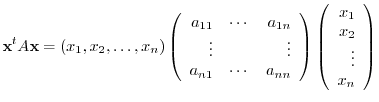
Also, for any -square real symmetric matrix and
 , the expression
 |
|
 |
|
|
 |
 using a matrix.
a
using a matrix.
a
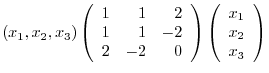
Answer
Since
 ,
,
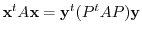
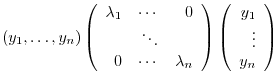
Suppose that a matrix is real symmetric. Then by the theorem4.2, is diagonalizable by the orthogonal matrix. So, let  be the orthogonal matrix so that
  is diagonalizable. Now set
 . Then
 |
|
 |
|
|
 |
 can be tranposed to standard form
 . Here,
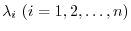 are eigenvalues of .
From this, we see the followings:
A real symmetric bilinear form  is said to be positive definite if eigenvalues of are all positive and for any
 ,
,
 .
A real symmetric bilinear form is said to be negative definite if eigenvalues of are all netative and for any
,
.
A real symmetric bilinear form is said to be negative definite if eigenvalues of are all netative and for any
,
 .
.
 using a matrix. Determine whether the matrix is positive definite. Find the standard bilinear form.
Answer The matrix for the bilinear form is
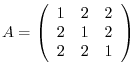
 , the eigenvector of are
  (multiplicity 2),
 . Thus, the bilinear form is not positive definite. Since is a real symmetric matrix, we can find the orthogonal matrix sothat is a diagonal matrix. Thus by putting
. then we have the standard bilinear form.
. Thus, the bilinear form is not positive definite. Since is a real symmetric matrix, we can find the orthogonal matrix sothat is a diagonal matrix. Thus by putting
. then we have the standard bilinear form.
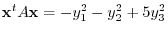
 using a matrix. Find the standard bilinear form.
Answer The matrix for this bilinear form is
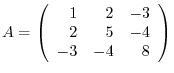
 . Then we can not find the eigenvalues of easily. So, we need a way to find the standard bilinear form without knowing eigenvalues.
Remember the regular matrix is a product of elementary matrices. So, to diagonalize, we can use the elementary operations.
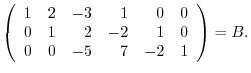
is a symmetric matrix. Then we apply
 to the
  and
and
 to the
  . Next we apply
 to the . Then we have
![$\displaystyle [A:I]$](img755.png) |
|
 |
|
 |
 |
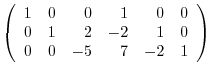
 to the columns
 . Then we have
 |
|
 |
|
|
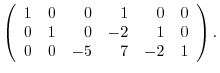 |
is a diagonalized matrix. Let
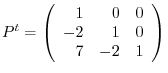 . Then
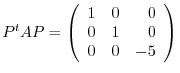
 |
|
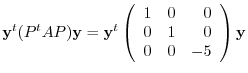 |
|
|
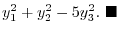 |
If is a complex square matrix, we can do the same thing as for a real square matrix.
Given any -square complex matrix and any vectors
 ,
,
|
|
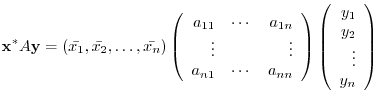 |
|
|
 |
||
|
 |
.
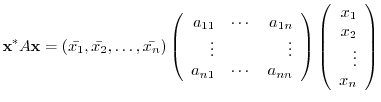
Suppose that is a Hermitian matrix of the order and
. Then
|
|
 |
|
|
 |
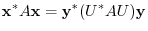
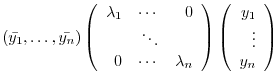
. In this case, is a Hermitian matrix, that is normal matrix. By the theorem 4.2, is diagonalizable by unitary matrix. Then choose the unitary matrix so that is diagonal matrix. Now let
 . Then we have
 |
|
 |
|
|
 |
 can be transformed to the standard form by the appropiate transformation
by the unitary matrix .
can be transformed to the standard form by the appropiate transformation
by the unitary matrix .
 are eigenvalues of .
1. Find the unitary matrix so that is diagonal.
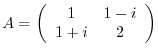
2. Find the orthogonal matrix so that is diagonal.
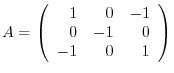
3. Find a condition so that
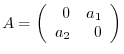 can be transformed to diagonal matrix by the unitary matrix.
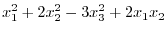
4. Find the orthogonal matrix so that the following bilinear form becomes the standard form.
5. Standarize the following Hermite matrix by using unitary matrix.
