線積分(line integrals)

2点 R,Q を結ぶ曲線 $C$ が与えられているとします. ただし,この曲線は滑らかな曲線とします.$C$ に沿って測った弧長を $s$ とします.すると5章で学んだように曲線上の点 $(x,y,z)$ は弧長 $s$ をパラメターとして表わすことができます.よって曲線 $C$ の方程式は

$\displaystyle {\bf r} = {\bf r}(s) = (x(s),y(s),z(s)) $

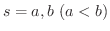
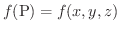
で表わせます.ただし $s = a,b \ (a < b)$ にはそれぞれ点 R,Q が対応しているとします.このとき曲線 $C: {\bf r} = {\bf r}(s)$ 上の任意の点P $(x,y,z)$ に対して定義されたスカラー場を $f({\rm P}) = f(x,y,z)$ とします.

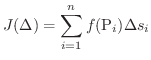
曲線 $C$$n$ 個の弧 $s_{1},s_{2},\ldots,s_{n}$ に分割し,この分割を $\Delta$ で表わします.各曲線 $s_{i}$ の弧長を $\Delta s_{i}$ とし, $s_{i}$ の中に任意の点 ${\rm P}_{i}$ をとり次の和を考えます.

$\displaystyle J(\Delta) = \sum_{i=1}^{n} f({\rm P}_{i})\Delta s_{i} $

ここで,この分割を細かくし $\Delta$ を限りなく小さくしたとき $J(\Delta)$ が極限値 $J$ に近づくならば,この極限値 $J$ をスカラー場 $f$$C$ に沿っての 線積分(line integral) といい,


$\displaystyle \int_{C}f({\rm P}) ds $


で表わします.曲線 $C$ が閉じているときは

$\displaystyle \oint_{C} f({\rm P}) ds $

と表わします.

線積分の定義は,今までの積分と同じRiemann和によるものなので,線積分においても次の公式が成り立つのは明らかです.

\begin{displaymath}\begin{array}{l}
1. \ \int_{C} k f({\rm P}) ds = k \int_{C}f(...
... = \int_{C} f({\rm P})ds + \int_{C}g({\rm P})ds \\
\end{array}\end{displaymath}


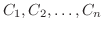
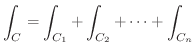
また,曲線 $C$ が滑らかではないが有限個の滑らかな曲線 $C_{1},C_{2},\ldots,C_{n}$ をつなげてできているとき,この曲線を 区分的に滑らかな曲線(piecewise smooth curve) といい,このような曲線に沿っての線積分は
$\displaystyle \int_{C} = \int_{C_{1}} + \int_{C_{2}} + \cdots + \int_{C_{n}} $

で表わせます.

例題 8..13  

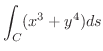
$\displaystyle{\int_{C}(x^3 + y^4)ds}$ を線積分してみましょう.ただし, $C$ は点 $(0,0,0)$$(1,1,1)$ を結ぶ直線とします.

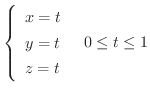
$(0,0,0)$ と点 $(1,1,1)$ を結ぶ直線をパラメター表示すると

$\displaystyle \left\{\begin{array}{l}
x = t\\
y = t\\
z = t
\end{array}\right. \ \ 0 \leq t \leq 1$

となります.よって曲線 $C$ ${\bf r}(t) = (t,t,t)$ で表わされ,曲線 $C$ の弧長 $s$

$\displaystyle s(t) = \int_{0}^{t}\Vert\frac{d {\bf r}}{dt}\Vert dt = \int_{0}^{t} \Vert(1,1,1)\Vert dt = \sqrt{3}t$

となります.これより $ds = \sqrt{3}dt$ となり,求める線積分は

$\displaystyle \int_{C}(x^3 + y^4)ds = \int_{0}^{1} (t^3 + t^4) \sqrt{3}dt = \sq...
...(\frac{1}{4} + \frac{1}{5}) = \frac{9\sqrt{3}}{20}
\ensuremath{\ \blacksquare}
$

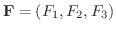
次に向きのついた曲線 $C : {\bf r} = {\bf r}(t)$$C$ の上で定義されたベクトル場 ${\bf F} = (F_{1}, F_{2}, F_{3})$ が与えられているとします.ここで $C$ の接線単位ベクトル $\hat{\bf t}$ を曲線 $C$ の正の方向(長さが増加する方向)での接線単位ベクトルとします.すると ${\bf F}\cdot \hat{\bf t}$$C$ 上で定義されたスカラー場となるので,このスカラー場の曲線 $C$ に沿っての線積分は

$\displaystyle \int_{C} {\bf F} \cdot \hat{\bf t} ds $

で表わせ,これをベクトル場 ${\bf F}$ の向きのついた曲線 $C$ に沿っての線積分といいます.特に

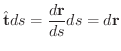
$\displaystyle \hat{\bf t} ds = \frac{d{\bf r}}{ds} ds = d {\bf r} $

に注意すると


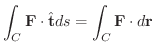
$\displaystyle \int_{C} {\bf F} \cdot \hat{\bf t} ds = \int_{C} {\bf F} \cdot d {\bf r} $


で表わすことができます.

ここでベクトル場Fが電場の場合を考えると, $\int_{{\rm P}}^{{\rm S}}{\bf F}\cdot d{\bf r}$ は正の電荷が点Pから点Sまで曲線 $C$ にそって移動するとき,電場Fが行なう単位電荷あたりの仕事と考えることができ,これを2点間の電位差または電圧といいます.

例題 8..14  

質点が楕円 $\displaystyle{\frac{x^2}{16} + \frac{y^2}{9} = 1}$ の回りを一周するのに行なった仕事を求めてみましょう.ただし,ベクトル場は

$\displaystyle {\bf F} = (3x-4y+2z,4x+2y-3z^2,2xz-4y^2 + z^3) $

$x = 4\cos{\theta}, y = 3\sin{\theta}$ とおくと.

$\displaystyle {\bf r} = {\bf r}(t) = (4\cos{t},3\sin{t},0), \ d{\bf r}(t) = (-4\sin{t},3\cos{t},0)dt$

また,

$\displaystyle {\bf F} = (12\cos{t} - 12\sin{t}, 16\cos{t} + 6\sin{t}, -36\sin^{2}{t}) $

よって

$\displaystyle \int_{C} {\bf F} \cdot d {\bf r} = \int_{0}^{2\pi} [48 - 30\sin{t}\cos{t}]dt = 96\pi
\ensuremath{\ \blacksquare}
$

例題 8..15  

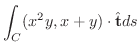
$\displaystyle{\int_{C}(x^2 y, x+y) \cdot \hat{\bf t}ds}$ を求めてみましょう.ただし, $C$ は曲線 $\displaystyle{y = x^2}$ の点 $(0,0)$ と点 $(2,4)$ を結ぶ曲線とします.


$\displaystyle \int_{C} {\bf F} \cdot \hat{\bf t} ds $ $\displaystyle =$ $\displaystyle \int_{C}{\bf F}\cdot d{\bf r}$  
  $\displaystyle =$ $\displaystyle \int_{C} (x^2 y, x+y)\cdot (dx,dy) = \int_{C} (x^2 ydx + (x+y)dy)$  
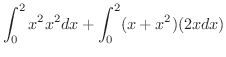
  $\displaystyle =$ $\displaystyle \int_{0}^{2} x^2 x^2 dx + \int_{0}^{2}(x + x^2)(2xdx)$  
  $\displaystyle =$ $\displaystyle \left[\frac{1}{5}x^{5}\right ]_{0}^{2} + \left[\frac{2}{3}x^{3} + \frac{2}{4}x^{4} \right ]_{0}^{2}$  
  $\displaystyle =$ $\displaystyle \frac{296}{15}$  

別解 曲線 $C$ をパラメター表示すると

$\displaystyle C : {\bf r}(t) = (x,y) = (t, t^2), \ 0 \leq t \leq 2 $

よって

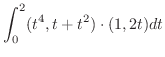
$\displaystyle d{\bf r} = (1,2t)dt, \ {\bf F} = (x^2y, x+y) = (t^4, t+t^2)$

これより
$\displaystyle \int_{C} {\bf F} \cdot \hat{\bf t} ds $ $\displaystyle =$ $\displaystyle \int_{C}{\bf F}\cdot d{\bf r}$  
  $\displaystyle =$ $\displaystyle \int_{0}^{2}(t^4,t+t^2) \cdot (1,2t)dt$  
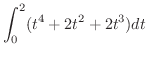
  $\displaystyle =$ $\displaystyle \int_{0}^{2}(t^4 + 2t^2 + 2t^3)dt$  
  $\displaystyle =$ $\displaystyle \left[\frac{1}{5}t^{5} + \frac{2}{3}t^{3} + \frac{2}{4}t^{4} \right ]_{0}^{2}$  
  $\displaystyle =$ $\displaystyle \frac{296}{15}
\ensuremath{\ \blacksquare}$  

この例題で $-C$ を曲線 $C$ の向きを $(2,4)$ から $(0,0)$ に変えた曲線とすると, 曲線 $-C$ のパラメター表示は

$\displaystyle -C : {\bf R}(t) = {\bf r}(2 - t) = (2-t, (2-t)^2), \ 0 \leq t \leq 2 $

となります.よって

$\displaystyle d{\bf R} = (-1,-2(2-t))dt, \ {\bf F} = (x^2 y, x+y) = ((2-t)^4, (2-t)+(2-t)^2) $

これより,

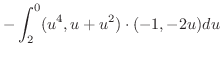
$\displaystyle \int_{-C}{\bf F}\cdot d{\bf R} = \int_{0}^{2} ((2-t)^4, (2-t)+(2-t)^2)\cdot(-1,-2(2-t))dt $

ここで $2-t = u$ とおくと, $du = -dt$ より
$\displaystyle \int_{-C}{\bf F}\cdot d{\bf R}$ $\displaystyle =$ $\displaystyle - \int_{2}^{0}(u^4,u+u^2) \cdot (-1,-2u)du$  
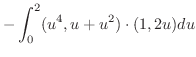
  $\displaystyle =$ $\displaystyle - \int_{0}^{2}(u^4,u+u^2) \cdot (1,2u)du$  
  $\displaystyle =$ $\displaystyle - \int_{C} {\bf F} \cdot d{\bf r}$  

よって,


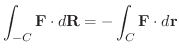
$\displaystyle \int_{-C}{\bf F}\cdot d{\bf R} = - \int_{C}{\bf F}\cdot d{\bf r} $

または,

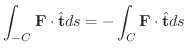
$\displaystyle \int_{-C}{\bf F}\cdot \hat{\bf t}ds = - \int_{C}{\bf F}\cdot \hat{\bf t}ds $


となります.

演習問題


1.
次の線積分を求めよう.

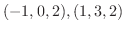
(a) $\displaystyle{\int_{C}x y^2 ds}$, Cは2点 $(-1,0,2),(1,3,2)$ を結ぶ線分

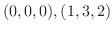
(b) $\displaystyle{\int_{C}(x + y^2) ds}$, Cは2点 $(0,0,0),(1,3,2)$ を結ぶ線分

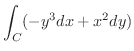
(c) $\displaystyle{\int_{C}(-y^3 dx + x^2 dy)}$, Cは $xy$ 平面上の単位円の点 $(1,0)$ から点 $(0,1)$ までの部分

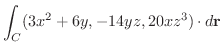
(d) $\displaystyle{\int_{C}(3x^2 + 6y,-14yz,20xz^3) \cdot d{\bf r}}$, Cは原点 $(0,0,0)$ と点 $(1,1,1)$ を結ぶ直線

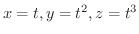
(e) $\int_{C}(3x^2 + 6y,-14yz,20xz^3) \cdot d{\bf r}$, Cは原点 $(0,0,0)$ と点 $(1,1,1)$ $x=t,y=t^2, z=t^3$ に沿って結ぶ曲線