Next: Differentiation Formnulas Up: Differentiation Previous: Differentiation Contents Index
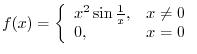
On the curve defined by 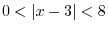 , as
, as  changes the value from
  to
to 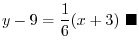 , the value of
 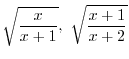 changes from
  to
to
 . Then the difference

 ,
,
 is called secant line.
As
 approaches 0 from the right, the secant line is getting close to the red line. Similarly, as approaches 0 from the left, the secant line is getting close to the same red line. This red line is called tangent line at
.
approaches 0 from the right, the secant line is getting close to the red line. Similarly, as approaches 0 from the left, the secant line is getting close to the same red line. This red line is called tangent line at
.
NOTE The slope of the secant line is given by
Differential Coefficient
Suppose that  is defined on an interval containing . If
exists, then we say
is defined on an interval containing . If
exists, then we say 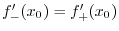 is differentiable at
  . The number
  is called differntiable coefficient at and denoted by
 . 2.1
. 2.1
 can be thought as the slope tangent line.
 at
at  .
.
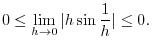
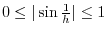
SOLUTION By the definition of differential coefficient, we have



SOLUTION By the definition of differential coefficient with
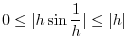 , we have
 |
 |
 |
|
|
 |
||
|
 |
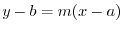
NOTE Since Equation of Tangent Line The equation of a tangent line for at
 is given by
 is the same as the slope of the tangent line, the slope of the line connecting two points
  and
and
 on the tangent line is equal to .
Equation of Normal Line A line perpendicular to a tangent line is called normal line.
The equation of a normal line to a function at
is given by
 at
at  . is
. is
 . Thus the equation of a tangent line is
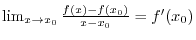

.  is
is 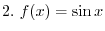 . Thus, the equation of the tangent line is


Left-Hand Differential Coefficient
exists. Then this value is called left-hand differential coefficient and denoted by

 .
.
NOTE By the definition of differentiable function, if
Right-Hand Differential Coefficient
exists. Then this value is called right-hand differential coefficient and denoted by

 .
and
exist and their values are equal, then is differentiable at .
.
and
exist and their values are equal, then is differentiable at .
SOLUTION We need to check the left-hand differential coefficient
 and the right-hand differential coefficient
 .
We first find
.
We first find
 .
.

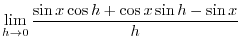 .
.
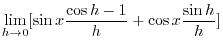
 is not differentiable at
.
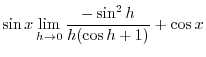
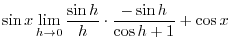
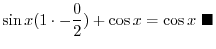
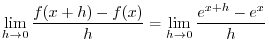 . Then
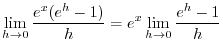
 and the function is differentiable at
Note that
is not differentiable at but continuous at . What kind of relation can we find between differentiablility and continuity.
Differentiability implies Continuity
Theorem 2..1 Suppse that
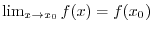
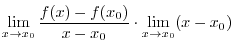
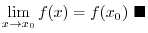
is differentiable at . Then is continuous at .
Proof Need to show
 . Rewrite
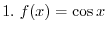 approaches . Then
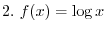 is differentiable at . Thus
 |
|
 |
|
|
 |

The converse of this statement is not true. In other words, continuity does not imply differentiability. see Example2.3.
NOTE The symbols of derivatives are
Derivatives If is differentiable at each point on some interval 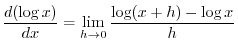 , then we say is differentiable on . In this case, we associate the value of to each point in to get Derivative which is define by

 , we say differentiate.
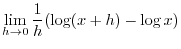
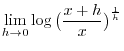
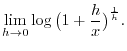
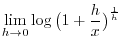
SOLUTION 1.
 |
|
 |
|
|
 |
||
|
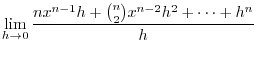
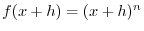
![$\displaystyle nx^{n-1} + \lim_{h \rightarrow 0}[\binom{n}{2}x^{n-2}h + \binom{n}{3}x^{n-3}h^2 + \cdots + h^{n-1}]$](img1407.png) |
||
|
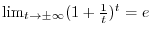 |
|
|
 |
|
|
 |
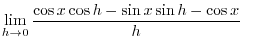
||
|
![$\displaystyle \lim_{h \rightarrow 0}[\sin{x}\frac{\cos{h} - 1}{h} + \cos{x}\frac{\sin{h}}{h}]$](img1416.png) |
||
|
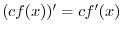 |
||
|
 |
||
|
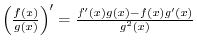 |
|
|
 |
|
|
 |
 . Then since
 , we have
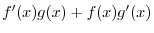 |
|
 |
|
|
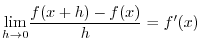 |
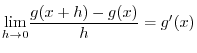


|
|
 |
|
|
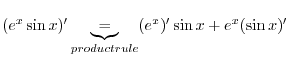 |
||
|
![$\displaystyle \lim_{h \rightarrow 0}[\cos{x}\frac{\cos{h} - 1}{h} - \sin{x}\frac{\sin{h}}{h}] \ \left(\frac{\cos{h} - 1}{h} \to 0, \frac{\sin{h}}{h} \to 1\right)$](img1435.png) |
||
|
 |
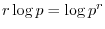
3. By the definition of the derivative, we have

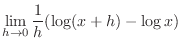 |
|
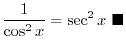 |
|
|
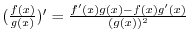 |
 . Then as implies
 . Thus
 |
|
 |
 , we have
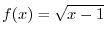
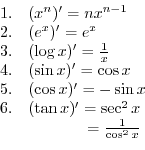
As you saw, finding the derivative of a function by the definition is not easy. So we show useful derivative formulas.
| Differentiation Formula |
|---|
|
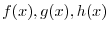
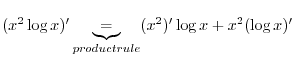
Theorem 2..2 Let
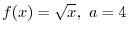 be differentiable and be differentiable and  be constant be constant
|
Proof
 .
.
 |
|
 |
|
|
 |
||
|
 |
||
|
 |


SOLUTION1.
 |
|
 |
|
|
 |
|
|
 |


 |
|
 |
|
 |
 |
||
|
 |
||
|
 |
|
|
 |
|
|
 |
|
Exercise A
|

|
Exercise B
|
![\includegraphics[width=11cm]{SOFTFIG-2/Fig2-1.eps}](img1319.png)