


Next: Scalar field, vector field Up: Differentiation / integration of Previous: Space curves Contents Index
The curve
![$\displaystyle C : \boldsymbol{r}(t) = (x(t), y(t), z(t)), \ t \in [a,b] $](img278.png)
![$[a, b]$](img126.png) is considered as the interval of time, and
is considered as the interval of time, and
 is considered as the position of the object in time
  .
For the motion
.
For the motion
 ,
,
 is called velocity.Also,
 is acceleration and expressed by
 .
Thus,,
.
Thus,,
|
As we have already learned, the tangent unit vector can be represented by
 and the velocity vector is
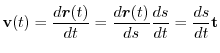
 ,
,
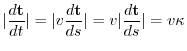
 is the rate or speed of change in arc length and denoted by
  . Thus
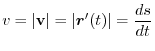
Next, to understand the acceleration a little better, let's consider the velocity vector.
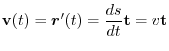

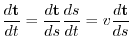
 |
 |
 |
|
|
 |
|

 , find
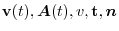 .
.
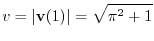
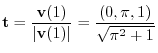
Answer

 ,
,
 |
|
 |
|
 |
|
 |
 .
Here we will consider a method that is easy to calculate.
.
Here we will consider a method that is easy to calculate.


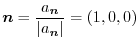
Other way is


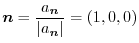
The vector

 and the normal vector
is called binormal unit vector. Also, the
and the normal vector
is called binormal unit vector. Also, the  satisfying

Now, let's examine the three unit vectors
 that have appeared so far.
and
is called osculating plane. the plane made by
and
 is called normal plane. the plane made by and
is called rectifying plane.
is called normal plane. the plane made by and
is called rectifying plane.
First,
are orthogonal to each other. Also, these vectors satisfies the following relations.
|
Proof
By the equation 2.1,
 . Also, by the definition of torsion,
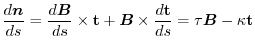
 .Next differentiate
 with respect to
  , we have
 ,find the followings. However,
  is an arbitrary positive constant.
 the arc length the curve for

 the unit tangent vector
 the normal vector
and the curvature
the normal vector
and the curvature 
 the binormal vector
and the torsion
the binormal vector
and the torsion
Answer
(a)
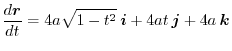 implies

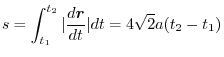

 より
より

 より
より
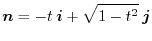
(d)


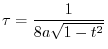


![\begin{figure}\vskip -1cm
\begin{center}
\includegraphics[width=8cm]{VECANALFIG/Fig5-2-2.eps}
\end{center}\vskip -2cm
\end{figure}](img205.png)
