


Next: Jordan Cannonical Form Up: Jordan Canonical Forms Previous: Jordan Canonical Forms Contents Index
 Generalized Eigenspace
Let  be
be  -square matrix and
  be a subspace of
 . For any vector
 in , if
 , then the subspace is called an A - invariant.
We write the characteristic polynomial in terms of multiplicity of characteristeic values.

 , we let



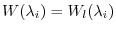 .
.
be the th order square matrix and its characteristic polynomial be (5.1). Then for the generalized eigen space
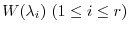 , the followings hold.
| (1) |
 |
| (2) | Generalized eigenvectors for different eigenvalues are linearly independent |
| (3) |
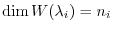 |
Proof
(1) For  , there exists a vector
so that
, there exists a vector
so that
 . Then there is a positive integer
  which satisfies

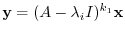 . Then

 , there is a positive integer
  which satisfies
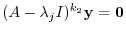 . But
. But
 implies
 . This contradicts the condition that for ,
 .
.
(2) Let
 be the distinct eigenvalues of . Then for
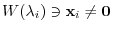
 , we show by induction that

 , it is obvious. We assume that


 , which satisfies
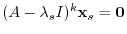 , to the equation (**) from the both sides.
 |
 |
||
 |
 |
 is
is
 -invariant,
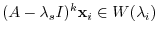 . Also, from (1), for
  ,
,
 . Thus,
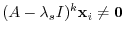
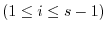 . Then by the induction hypothesis,
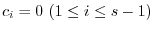 . Therefore,
 and we have
  .
.
(3) by the linearly independence shown (2), we have

 . So, to show (3), it is enough to show
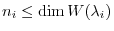
 い.
い.
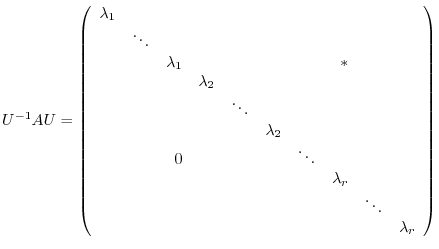
The matrix can be transformed to the following triangular matrix by using unitary matrix  .
.
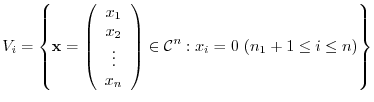
 is
is  th vector subspace of
. Also,
th vector subspace of
. Also,
 implies for every vector
of , we have
implies for every vector
of , we have
 is regular,
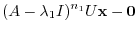
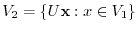 . Then
  is subspace included in
 and obtain the inequality
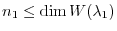 . Now switching the order of eigenvalues, we have
.
. Now switching the order of eigenvalues, we have
.

be the th square matrix and its characteristic polynomial be (*). Then an be transformed by  to the followings.
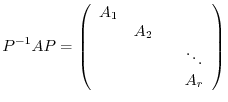
 is
is  th square matrix and its characteristic polynomial is
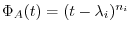 .
.
Proof
From
, we take the basis
 . Since
is -invariant, we have
. Since
is -invariant, we have

 . Then
  is th square matrix. By the theorem 5.1,
 . Therefore, we let
 is a regular matrix and
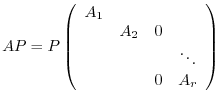
 , we obtain the required equation.
Using this relation,
 |
|
 |
|
|
 |
is
 only. Then we can show
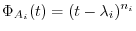 has the eigenvalues
 and the eigenvector corresponds to
are
and the eigenvector corresponds to
are
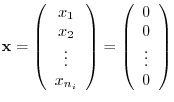
 and let
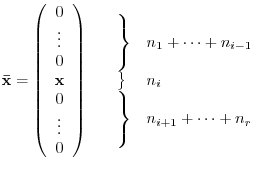
 で
で
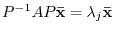 . Therefore,

 . In other words, it satisfies
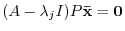 . But then this means that
 and this contradicts the theorem 5.1.
