


Next: Matrix Transformation and Eigen Up: Linear Mapping Previous: Linear Mapping Contents Index
 Mapping
In chapter 1 and chapter 2, we have studied about vector spaces. In this chapter, we study the relationship between two vector spaces. Before going to detail, we review about the mapping.
Consider two vector spaces  and
and  . For any element
  of , there is assigned a unique element
  of ; the collection,
  , of such assignments is called a mapping from to , and is written

 matrix represents a mapping which maps a
  th column vector to
  th column vector. In other words, it is a mapping from
 to
to
 .
.
Linear Mapping
In vector space, an addition and a scalar product are defined. So, a mapping between two vector spaces had better to satisfy an addition and scalar product.
 be vector spaces. Then the mapping
 is called a linear mapping if it satisfies the following two conditions.


 , We say the mapping is a linear transformation of .
A linear mapping from to is a mapping which preserves the properties of vector space.
The image of , written  , is the set of image point in :
 , written
 , is the set of elements in which map into
  :
:

The following theorems is easily proven.
 be a linear mapping. Then the image of is a subspace of and the kernel of is a subspace of .
 be the matrix with
. Let
be the matrix with
. Let
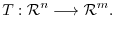
 . Then show that is a linear mapping.
Answer
For any vectors
 and any real number
  , we have

 is a linear mapping.

Suppose that the linear mapping
satisfies the following condition:
 is called a one-to-one or injective.
If a linear mapping
satisfies  , then is called onto mapping from to or surjective.
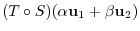
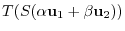
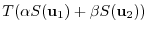
 are linear mappings. Then show that the compostion mapping
  is a linear mapping.
Answer
 |
 |
 |
|
|
 |
||
|
 |
 is a linear mapping..
Isomorphic Mapping
One-to-one and onto mapping is called an isomorphism. If there is an isomorphism from vector space to , Then we say and are isomorphic and denoted by  . If
is isomorphic and
. If
is isomorphic and
 , then set
 . Then we can find a mapping from to . This mapping is called an inverse mapping and denoted by
 .
.
 be a linear mapping. Then the following conditions are equivalent.


 is isomorphic. In other wordsm




 is isomorphic.
 If
If
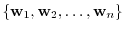 is the basis of
then the set of images of
is the basis of
then the set of images of  :
:
 は is the basis of .
Proof

Let the basis of be
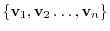 and
be the basis of
. Now define
as
and
be the basis of
. Now define
as
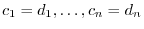
 . Then is a linear mapping (Excercise3.1). Also let
 . Then for some
 , we have


 |
 |
 |
|
|
 |
||
|
 |
||
|
 |
||
|
 |
is injective.
Next suppose that
 . Then
 . This shows that
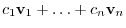 is the image of . Thus,
is injective. Therefore a linear mapping is bijective. This shows tha t is isomorphism.
is the image of . Thus,
is injective. Therefore a linear mapping is bijective. This shows tha t is isomorphism.

 . Then
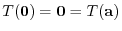 . By the assumption.
 . Thus,
 . Since is bijection, we have
 .
.
 is isomorphi, for any
 , we have
 . and
. and
 exist. By the linearlity of , we have

 is bijection. First of all, we show
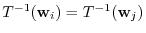 implies that
 .
.
 implies that
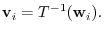 is isomorphic.
 is the basis of , it is enough to show this set is linearly indepenent and the vector space spanned by this set is .

 is isomorphic. Then

 is linearly independent. Thus, we have
 . Hence,

 . Then

 .
.
 is basis of . Thus,
.
is basis of . Thus,
.
Matrix Representation
To check a linear mapping of the finite dimensional vector space, we apply a matrix for the linear mapping. Then the properties of the linear mapping can be seen directly as the properties of matrices.
For example, consider the linear mapping which describes the rotation of the point on  plane with
  rotation to a point
  .
Consider the basis of
.
Consider the basis of  ,
,
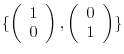 .
Then
.
Then
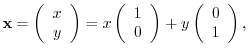
 |
|
 |
|
|
 |
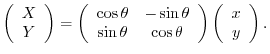
 . Let
. Let

 . Let
. Let
 and the image of be
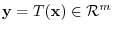

 , we have
 |
|
 |
|
|
 |
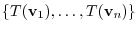 is in
, we can express as
is in
, we can express as

|
|
 |
|
|
 |
||
|
 |
||
|
 |
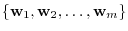 is the basis of
. Then the corresponding coefficients must be equal. So, we have the following relations:
is the basis of
. Then the corresponding coefficients must be equal. So, we have the following relations:
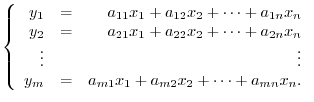
 . This matrix is called a matrix representation of on the basis
![$[T]_{¥bf v}^{¥bf w}$](img1147.png) . For , we take the basis of
of and the basis
. For , we take the basis of
of and the basis
 of to be the same and write
![$[T]_{¥bf v}$](img1149.png) . Also for
. Also for
 , the following usual basis
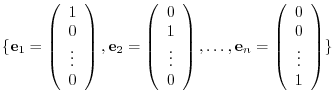 is given by
![$[T]_{¥bf e}$](img1152.png) or
or ![$[T]$](img1153.png) To summarize,
A linear mapping from
to
is represented by the
matrix which shows the image of the basis of
by the basis of
. Then it satisfies
To summarize,
A linear mapping from
to
is represented by the
matrix which shows the image of the basis of
by the basis of
. Then it satisfies
![$¥displaystyle [T({¥mathbf x})]_{¥bf w} = [T]_{¥bf v}^{¥bf w}[{¥mathbf x}]_{¥bf v} $](img1154.png)
 be given by
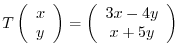 . Find the matrix representation of relative to the basis
 and the matrix representation of
 ![$[T]_{w}$](img1158.png) relative to the basis
relative to the basis
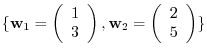 . Furthermore, find the matrix representation
![$[T]_{¥bf e}^{¥bf w}$](img1160.png) of relative to
of relative to
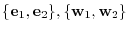 .
.
Answer
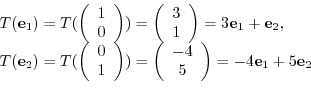
![$[T] = ¥left(¥begin{array}{cc}
3&-4¥¥
1&5
¥end{array}¥right)$](img1163.png) .
.
 |
|
 |
|
 |
|
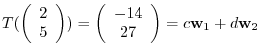 |
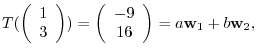
 implies that
 . Thus,
![$[T]_{¥bf w} = ¥left(¥begin{array}{cc}
77&124¥¥
-43&-69
¥end{array}¥right)$](img1170.png) .
.
 |
|
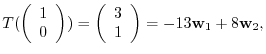 |
|
 |
|
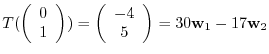 |
![$[T]_{¥bf e}^{¥bf w} = ¥left(¥begin{array}{cc}
-13&30¥¥
8&-17
¥end{array}¥right)$](img1175.png) .
.
Let be a linear mapping
. Then  is a set of all elements of
so that the image of is
is a set of all elements of
so that the image of is  . In other words, it is the same as the solution space of the system of linear equations.
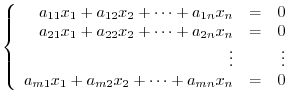

 . is the set all images of elements in
. Then
. is the set all images of elements in
. Then
 . From this, we have the following theorem.
be a linear mapping. Then the following is true.

 by
by
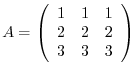 . Find the
 .
.
Answer
Since
is the same as
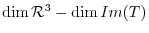 . Also,
. Thus if we find the
. Also,
. Thus if we find the
 , then we can find
.
, then we can find
.
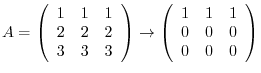
 . Thus
 .
.
Given vector spaces
 , there is a linear mapping
  such that

 is also linear mapping. (see Example3.1). Then take basis for each vector space and let the matrix representation for linear mappings
  be
be  . Then for
 , we have
 is
is  .
.
 relative to the basis
 be . Then the followings areequivalent.
is isomorphic.
The matrix is regular.
be . Then the followings areequivalent.
is isomorphic.
The matrix is regular.
Proof
Let the matrix representation of
be . Since is isomorphic, exists. Now let the matrix representation of be  . Then
  and is regular.

Suppose that is regular. Then there is a matrix such that . Now let be the linear mapping on . Then
 . Thus, by Exercise 3.1, is isomorphic.
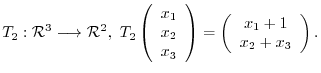
1. Determine whether the following mapping is linear mapping.
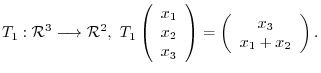
2. Let be the dimensional vector space. Let
be the basis of . Define
by
 . Then show that is a linear mapping.
3. Let
be a linear mapping. Then the followings are equivalent.
is isomorphic.
such that
and
 .
.
4. Suppose that
is a linear mapping. Show that
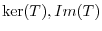 are the subspace of .
5. Let
be a linear transformation such that
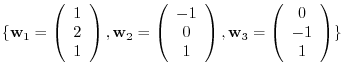
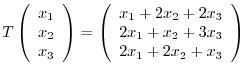 . Find the matrix representation of relative to the usual basis
 . Find also
![$[T]_{¥bf w}$](img1208.png) relative to the basis
relative to the basis
 .
.
また
を求めよ.