Next: Limit of Functions of Up: Partial Differentiation Previous: Partial Differentiation Contents Index
 be a subset of
 . Then for each point
  in , there is a rule
  such that there exists a unique
  corresponding to . We call this rule a function of two variables and denote by
 .
.
NOTE Let be a domian.  and
and  are called independent variable and is called dependent variable. A function
is called a function of two variables of
are called independent variable and is called dependent variable. A function
is called a function of two variables of  .
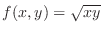
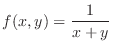
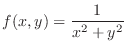
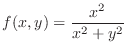
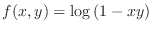
The domain of is the set of variables of for which
.
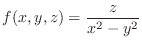
The domain of is the set of variables of for which  is also a real.
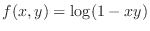
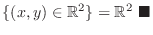
 is the set of real numbers such that
 is a real number. Thus
 |
 |
 |
|
|
 |

SOLUTION
Note that
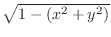 is real if and only if
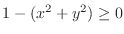 . Thus
|
|
 |
|
|
 |

For the function
, the set of points  such that
 is called graph.
Thus the graph of a function of two variables is a surface.
is called graph.
Thus the graph of a function of two variables is a surface.
NOTE A surface is a collection of points. But it is not easy to draw a surface by plotting points. Then to draw the surface of a function of
, we use the following techniques.
If we look at the surface of a function from the direction of -axis, then we can only see the curve on  -plane.
If we look at the surface of a function from the direction of -axis, then we can only see the curve on
-plane.
If we look at the surface of a function from the direction of -axis, then we can only see the curve on  -plane.
From these observation, we can draw the surface of a function by drawing the curve of a function
-plane.
From these observation, we can draw the surface of a function by drawing the curve of a function
 on the -plane and the curve of a function
 on -plane.
Finally, we let
on -plane.
Finally, we let  and draw the curve on the plane parallel to the
  -plane.
A line of intersection of a plane and
is called contour or level curve.
NOTE Let be a position of object on the -plane and
be the atomospheric pressure at the point. Then is the plane whose atomosphric pressure is  . Thus
 is the level curve of the atomospheric pressure .
SOLUTION
Let  to get
 . Then we have a parabola on -plane. We next let
  to get
 . Then we have a parabola on -plane. Finally let to get
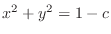 . Thus we have a circle with the radius
 on
on
 2.
2.
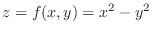 .
.  by squaring both sides to get
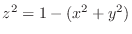 . Then htis is a sphere with the radius 1.
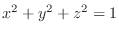 . Since
  , we have upper semisphere.
. Then
, we have upper semisphere.
. Then
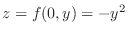 . Thus we have a concave up parabola on -plane. Let . Then
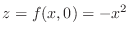 . Thus we have concave down parabola on -plane. Finally let . Then we have hyperbola
 . To sketch this, imagine the saddle on a horse back
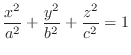
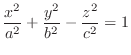
We classify the surface represented by the following quadratic equation.

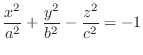
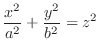


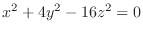 2.
2.
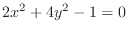
 , we have
 . Then
 ,
,
 lines. Also for , we have
 lines. Thus, it is a quadratic cone
2. For , we have
lines. Thus, it is a quadratic cone
2. For , we have
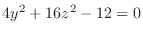 . Then
 , ellipse. Also for , we have
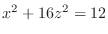 . Thus
 ellipse. Thus
, it is a ellipsoid
ellipse. Thus
, it is a ellipsoid
 2.
2.
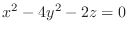
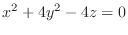
 , the value of can be arbitrary. Thus we have a parabola for all . Thus it is a parabolic cylinder
2. Since
, the value of can be arbitrary. Thus we have a parabola for all . Thus it is a parabolic cylinder
2. Since
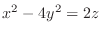 , for , we have
  a parabola. for , we have
 a parabola. Also for , we have
 a hyperbola. Thus it is a hyperbolic paraboloid
Exercise A
Exercise B