


Next: Exercise Up: 1st Order Differential Equation Previous: Exercise Contents Index
If a 1st order differential equation
 is put into the form


 and
and
 . Substitute these into the above equation, we have


 to get the general solution.
If a function  satisfies
 , then we say is the homogeneous function of degree
  .
.
Given
 and
and  are the homogeneous functions of the same degree, then the differential equation is homogeneous.
 .
.
SOLUTION
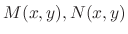 are the homogeneous functions of the same degree 1. Divide the numerator and the denominator by
  . Then
 . Then
 and
and


 as base to get


 to obtain the general solution

 .
.SOLUTION This is not homogeneou. But once we can get rid of the constant term, it becomes homogeneous. The intersetion of two lines

 . we move the axis so that is the origin. Let
 . Then
 and
and


 , we have

 .
.
SOLUTION
Let  . Then
  and
and
 . Put this back into the original differential equation to obtain


