


Next: Systems of differential equations Up: Linear Differential Equations Previous: Exercise Contents Index
 . Then we can write


 for
for
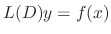 is called the Inverse operator and is expressed by

 applies to the function of
  such that

Basic rule
 be sonstants,
  be functions. Then


Proof The first one comes from the definition of  . The second one comes from the following.

 be a constant and
  be an integer. Then


Proof Let
 . Then
 . Thus

 . Multiply the
  both sides


 |
 |
 |
|
|
 |
||
|
 |
 |
|
 |
|
 |
|
 |
|
 |
|
 |
|
 |
|
 |
|
 |
|
 |
|
 |
|
 |
 .
.
SOLUTION
The characteristic equation of  is
is
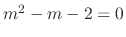 . Thus roots are
  . Then the complementary solution
  is given by
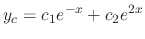
 , by (1) above

 and the general solution is

 .
.
SOLUTION The characteristic equation of is
 . Thus
 . Then the complementary solution is

 , we have
 and
and


SOLUTION Let  be the particular solution. Then since
 , we have
 |
|
 |
|
|
 |
||
|
 |