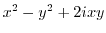
Next: Complex integration Up: Analytic function,holomorphic function Previous: Analytic function,holomorphic function Index
 defined in the region
  and a point
  in ,
in ,

 is said to be differnetiable at
  and this limit is denoted by
  . Furthermore, this is called coefficient of derivative at .
When all  in are differentiable, the derivative
  is a function of in . This is called a derivative of and denoted by
 .
.
(1) If  are differentiable in , then the followings hold.
(i)

(ii)

(iii)
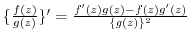
(2) If  is differentiable in
  , is differentiable in , then the composite function
  is differentiable in and
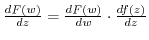 .
.
(3) If is differentiable, then is continuous.
A function
 defined in is differentiable at
 in . Then keeping
  constant and bringing
  colser to 0, we have

 constant and bringing closer to 0, we hafe

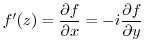
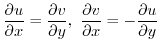
defined in is differentiable at
if and only if
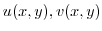 is totally differentiable at
 and satisfies
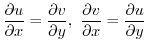
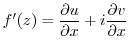
When is differentiable at any point in the domain , is said to be analytic in .
An analytic function in  entire plane
 is called entire function.
Note1. When a function is analytic at , it means that it is analytic including not only but also its neighborhood.
Note2. If is analytic, it is continuous (becouse it is differentiable).
 is analytic in and if the second partial derivatives of
  are continuous, then is harmonic function. That is it satisfies Laplace's differential equation.

Note We assumed that  and
and  have continuous second-order partial derivatives, but We don't need this assumption because the holomorphic function is separately proved to be differentiable many times.
satisfies the Cauchy-Riemann's equation in the region and it has a continuous partial derivatives, then
is analytic in . Note This theorem is a strong enough condition and effective for determining anayticity.
 ,
,
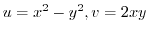 are polynomials and its partial derivatives are continuous. Furthermore,
 . Thus by the theorem 3.6,
  is analytic on whole plane.
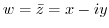 ,
,
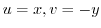 . Then
  and
and
 are not equal. Then the condition for anlytic in Cauchy-Riemann's equation is not satisfied. Thus,
 is not analytic.
is analytic and
 , prove that is constant. is analytic, by the theorem 3.4, we have
 . Thus,
 . Therefore,
are constants. Thus,
is also constant.
. Therefore,
are constants. Thus,
is also constant.
 is a harmonic function, and find the holomorphic function
 that has this in the real part.


 implies
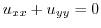 . Then
  is a harmonic function. Next,
is analytic. Then by Cauchy-Riemann's equation
is a harmonic function. Next,
is analytic. Then by Cauchy-Riemann's equation
 . Then
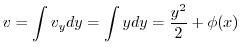
 is a function of only. Put this into latter equation, we have
 .
Thus,
.
Thus,
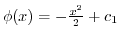 . This shows that
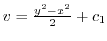 . Therefore,

(2)
 implies
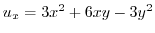 ,
,
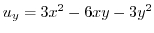 ,
,
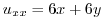 ,
,
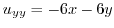 . Then,
. Thus, is a harmonic function. Next,
is analytic. Then by the Cauchy-Riemann's equation, we have
. Then,
. Thus, is a harmonic function. Next,
is analytic. Then by the Cauchy-Riemann's equation, we have
 . Then
 is a function of only. Now puttin this into the latter equation, we have
 .
Thus,
.
Thus,
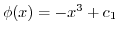 . This implies that
 . Therefore,
 |
 |
 |
|
|
 |
||
|
 |


2. Differentiate the following functions.


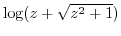


3. When
 , check the analyticity of the following functions and if it is analytic, find the derivative.