


Next: Tangent Plane and Normal Up: Partial Differentiation Previous: Partial Derivatives Contents Index
A function
 is defined on the region
  . Let
. Let
 be the increment of
  and
and  . Then
 is called an increment of
  and denoted by
  .
.
If  is partially differentiable, then



 , then we say a function
is totally diferentiable at
, then we say a function
is totally diferentiable at 
NOTE Note that we can express as

 is an increment of
  as moved to
 . Then we can write

 is an increment of as moved to
 . Then we can write


The differential of is denoted by  . Then for
is totally differentiable at , Let
. Then for
is totally differentiable at , Let
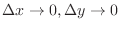 . Then
 , where
 can be expressed as
 . Thus we write

 is called taltal differential of .
 2.
2.
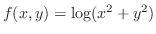 3.
3.


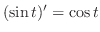
SOLUTION
1.


2.


3.

![$\displaystyle \sqrt{27}\sqrt[3]{1021}$](img328.png)
Since
![$\sqrt{25}=5, \sqrt[3]{100} = 3$](img329.png) , we approximate using these values. Increment of
can be approxiamted with the total differential of that is .
, we approximate using these values. Increment of
can be approxiamted with the total differential of that is .
SOLUTION
Consider the function
![$f(x,y) = \sqrt{x} \sqrt[3]{y} = x^{\frac{1}{2}}y^{\frac{1}{3}}$](img330.png) . Let
. Let
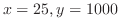 . Then
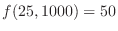 . Now let
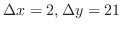 . Then
 . Note that
 . Thus

 Thus for
 , we have
 . From this,
![$\displaystyle{\sqrt{27}\sqrt[3]{1021} \approx \sqrt{25}\sqrt[3]{1000} + 2.35 = 52.35 \ensuremath{ \blacksquare}}$](img340.png)
| Total Differentiability |
|---|
Use the contrapositive of Theorem4.2, if is not continuous at  , then is not totally differentiable at , then is not totally differentiable at  . .
|
NOTE Suppose that is totally differentiable at
 , then
 .
Now we show that is continuous at . In other words, we show
.
Now we show that is continuous at . In other words, we show

 . Then
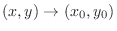 is equivalent to
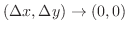 . Thus,
![$\displaystyle \lim_{(\Delta x, \Delta y) \rightarrow (0,0)}[f(x_{0} + \Delta x, y_{0} + \Delta y) - f(x_{0},y_{0})] = 0$](img352.png) is continuous at
.
is continuous at
.
is partially differentiable with respect to  at and
  are continuous at . Then is totally differentiable at .
| Check |
|---|
 and and
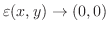
|
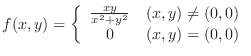
SOLUTION
 Then
Then

| Check | ||||||||
|---|---|---|---|---|---|---|---|---|
By Example4.8,
 Then
Then
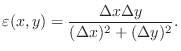 is totally differentiable at
  only if only if
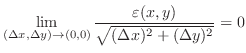
 . Then . Then
Then this limit depends on the value of  . Thus it is not totally differentiable . Thus it is not totally differentiable
|
| Check |
|---|
is totally differentiable at
 is continuous at
. Now take the contrapositive to this statement. Then is not continuous at
is not totally differentiable at
. is continuous at
. Now take the contrapositive to this statement. Then is not continuous at
is not totally differentiable at
.
|
Alernative Solution By Example4.8, is partially differentiable at . But by Example4.4, is not continuous at . Thus by Theorem4.2, is not totally diffrentiable at
.

SOLUTION
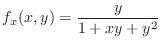 and
and
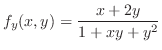 . Then
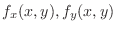 is continuous at . Thus by Theorem4.3, is totally differentiable at .
Altenative Solution
 and
,
. Then
and
,
. Then

 Thus,
Thus,
 |
 |
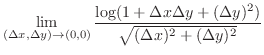 |
 . Then
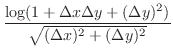 |
|
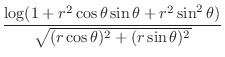 |
|
|
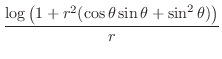 |
 . Then
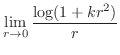 |
 |
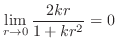 |
is totally differentiable at
A vector orthogonal(perpendiculr) to the plane is called normal vector.
Thus the vector such as
 is a normal vector.
![\includegraphics[width=3.5cm]{SOFTFIG-4/totaldiff.eps}](img304.png)




![% latex2html id marker 25715
\includegraphics[width=3.5cm]{SOFTFIG-4/reidai4-10_gr1.eps}](img356.png)
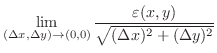
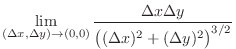
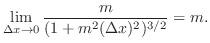
![\includegraphics[width=3.5cm]{SOFTFIG-4/tangentplane.eps}](img385.png)