


Next: Taylor's Theorem Up: Differentiation Previous: Mean Value Theorem Contents Index
 and
and  be continuous on
 ![$[a,b]$](img1050.png) adn differentiable on
adn differentiable on  . If
. If
 and
and
 and
and
 never takes 0 simultaneously, then there exists at leat one number
 such that
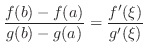
| This is wrong Apply the Mean Value Theorem to and . Then


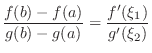
 and and  are equal. are equal.
|
| Check |
|---|
 . Then . Then
 . .
|
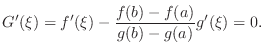
We consider a function which satisfies the conditions of Rolle's Theorem. Let

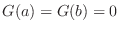 and
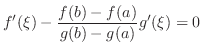
and  satisfies the conditions of Rolle's Theorem. Thus there exists at least one number
such that
satisfies the conditions of Rolle's Theorem. Thus there exists at least one number
such that
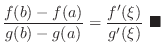
 , then
 and this violates the assumption. Therefore,
 and
and
L'Hospital's Theorem
and be continuous on and differentiable on . If
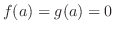 and
and
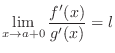 exists, then
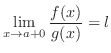 .
.
L'Hospital's Theorem 1. First make sure that limit is in indeterminate form of either
 or
or
 .
.
2. Differentiate the numerator and denominator separetely.
3. After differentiation, Simplify the expression.
4. If it is indeterminate form again, repeat 2.3.
Proof
Let  be such that
  and consider
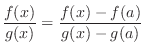 such that

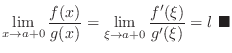
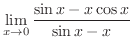
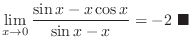
SOLUTION
This is indeterminate form of
 . Then differentiate the numerator and denominator separately, we have
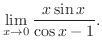 . So, differentiate the numerator and denominator separately, we have
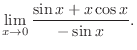 . So, differentiate the numerator and denominator separately, we have
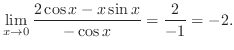
| Check |
|---|
 . .
|
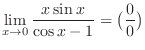
To find the limit by L'Hospital's Theorem, we usually write in the following way.
|
 |
 |
|
 |
 |
||
|
|
| Symbol |
|---|
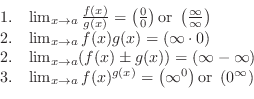
In this paper, when we apply L'Hospital's rule, we use the following symbol
 . .
|

Other than
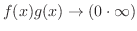
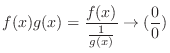
 Note that L'Hospital's theorem only can apply
 . Other indeterminate form appears, you must change into
.
. Other indeterminate form appears, you must change into
.
1.

 |
|||
|
 |
||
 |
 |
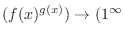 or
or

 or
or
Note that this is indeterminate form of
 . Then we replace
 by
by
 . Then it is indeterminat form of
. Thus by L'Hospital's Theorem, we have
. Then it is indeterminat form of
. Thus by L'Hospital's Theorem, we have
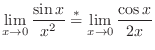
 . Thus no limit exists

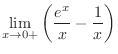
SOLUTION
This is indeterminate form of
 . Then replace
 by
by
 . Then it is indeterminate form of
. Thus
. Then it is indeterminate form of
. Thus
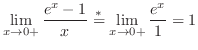
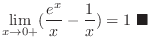
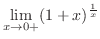
SOLUTION
This is indeterminate form of
 . So we rewrite
 into
into
 . Then
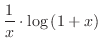 is indeterminate form of
. Thus replace
by
is indeterminate form of
. Thus replace
by
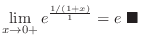
 . Then in the form of
. Thus
. Then in the form of
. Thus
|
|
 |
|
|
 |
Exercise A
Exercise B


