


Next: Two-dimensional probability distribution Up: Random variables Previous: Random variables Contents
 that takes
  values ?such as
 , the probability that
  is
is  is given, is called random variable.
and the corresponding probability
is given, is called random variable.
and the corresponding probability
 is called probability distribution.
is taken up to a certain value
is called probability distribution.
is taken up to a certain value  is expressed by
  , and is called the distribution function of the random variable . Thus,
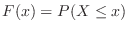 .
.
If the random variable has a finite number or an infinite number of values ??but is numbered by a natural number, the random variable is said to be discrete type. Also, if the random variable can take all real numbers in an interval, it is said to be continuous type..
Discrete type
The value taken by the random variable is
, and the probability of each event
 is
is
 . Then

 is
is
 is
is
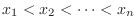 ,the distribution function
  can be obtained by

The probability distribution and the distribution function  have the following properties:.





Continuous type
When the random variable takes a continuous value, the probability of the event
 is determined by the continuous function , where
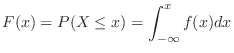 is called the distrubution function of and
  is called probability density function.
(1) Assuming that the birth rates of boys and girls are equal, find the value of the random variable and the probability distribution for a household with four children.
.
(2) One bag contains 4 red balls and 6 white balls. To take out three balls at the same time, find the random variable and the probability distribution , which represent the number of red balls, and draw the graph. Also, find
 .
.
3. Given
 and the function
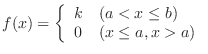
.
 for to be a probability density function?
 for
for  , which is
 .
.
4. The probability density is given by
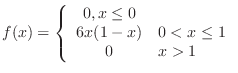
.
 ,
,
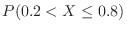 .
.
5. A function is given by
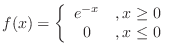 gives a probability density function.
 so that
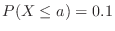 ,
,
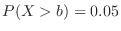 .
.
1. Let be the number of boys in a household with 4 children,Then
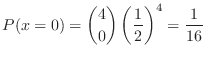
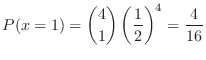
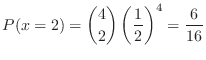
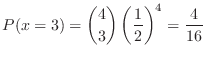
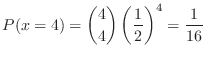 is given by
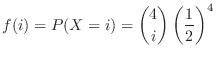
2. There are
 combinations for extracting 3 out of 10. Also, the fact that red is zero out of three means that white is the same as three, so three are taken out from six whites, and the combination is
 . Therefore, if is the number of red balls,
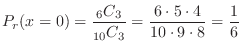

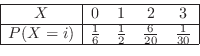

3.
(a) For to be a probability density function, we need to show the followings are satisfied.

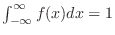
Then,
1. If the constant is 0 or more,
 is satisfied.
2.
 . Then we set
 .
.

(4)
(a) Note that the distribution function is given by
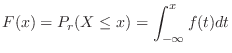
For  ,
,
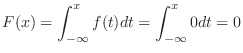
 ,
,
 |
 |
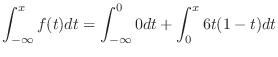 |
|
|
![$\displaystyle 0 + \left[3t^2 - 2t^3\right]_{0}^{x} = 3x^2 - 2x^3$](img255.png) |
 ,
,

 |
|
![$\displaystyle P_{r}(0 < X \leq 0.7) = F(0.7) - F(0) = \left[F(x)\right]_{0}^{0.7}$](img259.png) |
|
|
![$\displaystyle \left[3x^2 - 2x^3\right]_{0}^{0.7} = 3(0.7)^2 - 2(0.7)^3$](img260.png) |
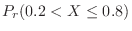 |
|
![$\displaystyle \left[F(x)\right]_{0.2}^{0.8} = \left[3x^2 - 2x^3\right]_{0.2}^{0.8}$](img262.png) |
|
|
 |
4.
We need to show
and
.
1.
 is exponential function. So, for all ,
  .
.
2.
 |
|
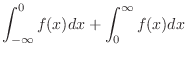 |
|
|
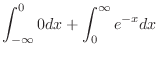 |
||
|
![$\displaystyle \left[0 + -e^{-x} \right]_{0}^{\infty -} = 1$](img269.png) |

 .Therefore,


 that satisfies
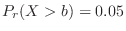 is
is


