


Next: Matrix and Determinant Up: Vector Space Previous: Linearly independent, Linearly dependent Contents Index
When an addition and a scalar multiplication are defined in a subset of vector space, it becomes a vector space. The vector space is called a subspace.
 be a vector space and
  be a subset of . Then is a subspace of if and only if

 in implies that the sum
 is also in .
 w is in implies that the scalar multiple
 is in .
A subspace is itself a vector space. In other words, it satisfies the properties 1 thru 9 of the vector space. In the definition of subspace, we checked only closure property. Other properties are inherited from the vector space .
There is a way to create a vector space quickly.
A set of the linear combination of vectors
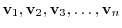 can be written as
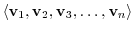 . It is called a linear span by vectors
. This is a vector space.
. It is called a linear span by vectors
. This is a vector space.
is a vector space
Answer
Let
 be elements of
. Then
be elements of
. Then
 |
 |
 |
|
 |
|
 |


 v are in
.
v are in
.

![$C[a,b]$](img337.png) is a subspace of
is a subspace of ![$PC[a,b]$](img138.png) .
.
Answer
Suppose that
![$f(x),g(x) \in C[a,b]$](img338.png) . Then, since the sum of continuous functions is continuous and the scalar multiple of continuous function is continuous, we have
. Then, since the sum of continuous functions is continuous and the scalar multiple of continuous function is continuous, we have
![$f(x) + g(x) \in C[a,b], \alpha f(x) \in C[a,b]$](img339.png) .
.
 be subspaces of vector space . Then show the intersection
  and
and  are subspace of . Note that


Answer
Let
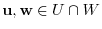 . Then
 and
and
 . Thus by closure property
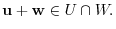
 and
and
 . Thus, we have
 is a subspace of .
Suppose that
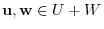 . Then
 .
Thus,
.
Thus,

 is a subspace of .
For , if an element w of is expressed uniquely in the form
 . Then we say is a direct sum of
  and and denoted by
 .
.
 Basis
Basis
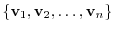 has the following properties. Then it is said to be basis of the vector space .
 are linearly independent each other.
can be expressed in a linear combination of
. That is
are linearly independent each other.
can be expressed in a linear combination of
. That is
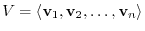 . In this case, we say the set of
span the vector space.
. In this case, we say the set of
span the vector space.
It is obvious that every set of linearly independent vectors can not be a basis. For example, consider the set of vectors
 . the set of
is linearly independent. But for any real values
. the set of
is linearly independent. But for any real values
 ,
,
 is impossible.
Let the largest number of linearly independent vectors in
be  . Then consider
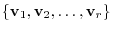 . Then the rest of vectors
 are linearly dependent of
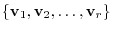 . Thus, we have the next theorem.
Dimension
. Choose a linearly independent vectors
from
. Then we have
 is a basis of and is said to be dimension and denoted by
 .
.
 be a set of vectors on the plane
 . Then
 and dimension of .
Answer
We first show that
 is a subspace of
  .
Let
.
Let
 be elements of . Then we can write
 . Thus,

 is a subspace of .
Next let  be an element of . Then we express s using
 . Since
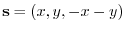 . we can write
 can be expressed by a linear combination of
 and
and
 . Also,
and
are linearly independent. This shows that the set of
and
is the basis of . Therefore,
. Also,
and
are linearly independent. This shows that the set of
and
is the basis of . Therefore,
 .
.
Before moving to the next section, we study the dimension about sum space and intersection space. Proof can be seen in Exercise1.4.
be subspaces of a vector space . Then

Diagonalization of Gram-Schmidt
We have learned in 1.2 how to create an orthonormal system from an orthogonal system. In this section, we learn how to create an orthonormal system from the independent vectors. Give  vectors
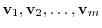 . Suppose the following holds
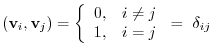 vectors form an orthonormal system. The
 here is called a Kronecker delta. We have seen a few examples of an orthonormal system in 1.2. Now if you look very carefully, these examples are all independent.
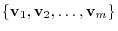 forms an orthonormal system, then they are independent.
Proof
Let
 and make an inner product with
 . Then
 |
|
 |
|
|
 |
||
|
 |
||
|
 |
 are 0. Thus,
is linearly independent.
are 0. Thus,
is linearly independent.
Conversely, given a set of linearly independent vectors, is it possible to create an orthonormal system?
Suppose that a set of vectors
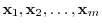 is linearly independent. Then all vectors
 (why?). Now let
 . Then
is a unit vector. Next we choose a vector which is orthogonal to the plane formed by vectors
. Then
is a unit vector. Next we choose a vector which is orthogonal to the plane formed by vectors
 and
for sides. Then we let
and
for sides. Then we let
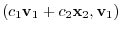
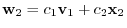 be a vector orthogonal to
. Then
be a vector orthogonal to
. Then
 |
|
 |
|
|
 |
||
|
 |
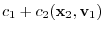
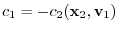 .
Therefore,
.
Therefore,

 are linearly independent. we have
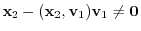 .
Then for
.
Then for
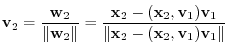
 .
.
Next we find the unit vector
 which is orthogonal to vectors
and
which is orthogonal to vectors
and
 . Consider a linear combination of
 and
and
 . i.e.
 . Then



 are linearly independent, we have

 and
Similarly, continue this process by letting
and
Similarly, continue this process by letting
 which forms an orthonormal system. We call this process Gram-Schmidt orthonormalization.
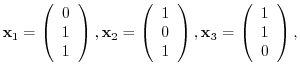
Answer
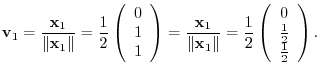
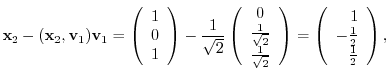

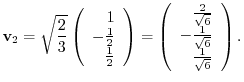


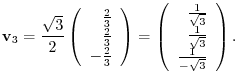
 forms an orthonormal system.
1. Determine whether
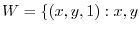 real
real is a subspace of the vector space .
2. Show that
 real is a subspace of the vector space .
3. Find the basis of a vector space
real . Find the dimension of .
4. Show the following set of vectors is a basis of the vector space .
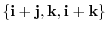
5. Find the dimension of the following subspace.
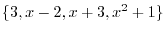
6. From the vectors
 , create an orthonormal system.
7. Let be subspace of a vector space . Show the following dimensional equation holds.
8. Show that any set of vectors with more than 4 vectors in 3D vector spaceis linearly dependent.