


Next: 5.2 Residue Up: Solution Previous: 4.4 Cauchy's integral formula Index
1. Laurent expansion around  is expressed by
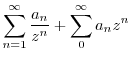
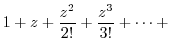
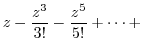
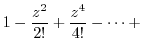
To find Laurent expansion, it is useful to know the following Taylor expansion..
 |
 |
 |
|
 |
|
 |
|
 |
|
 |
|
 |
|
 here here |
(a) Since  ,
,
 can be Taylor expanded. First we expand
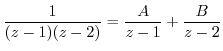
 by using partial fraction expansion. Then
 |
|
 |
|
|
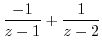 |
Note that
 . Then
 , we write
 by
by
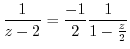
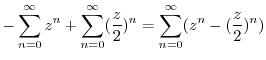
 . Then we can use Taylor expansion.
 |
|
 |
|
|
 |
|
|
|
|
|
 |
||
|
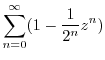 |
(b) Since
 ,
can not be Taylor expanded. But if we write
,
can not be Taylor expanded. But if we write
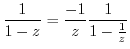
 . Thus we can use Taylor expansion.
We expand
using partial fraction expansion.
. Thus we can use Taylor expansion.
We expand
using partial fraction expansion.
|
|
|
|
|
|
 , we write
 by
by
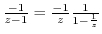 .
.
 |
|
 |
|
|
 |
||
|
 |
 , we write
by
, we write
by
. Then we can use Taylor expansion.
|
|
|
|
|
 |
|
|
|
|
|
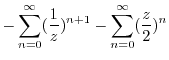 |
(c) Since  ,
can not be Taylor expanded. But if we write
,
can not be Taylor expanded. But if we write
. Thus it can be Taylor expanded.
We expand
using partial fraction expansion.
|
|
|
|
|
|
, we write
by
.
|
|
|
|
|
|
||
|
|
, we write
by
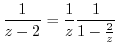
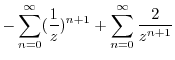
 . Then it can be Taylor expanded. Thus
|
|
 |
|
|
 |
|
|
|
|
|
 |
||
|
 |
2.
(a) Since it is a Laurent expansion with , we do not do anything with
 . Thus we expand
 using Taylor expansion. Then

 |
|
 |
|
|
 |
||
|
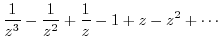 |
Note that the singularity 0 is the 3rd pole.
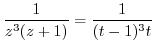
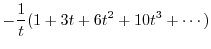
(b) For Laurent expansion of  , let
, let  . Then
 .
Now we have nothing to do with
.
Now we have nothing to do with
 . Thus, we expand
 using Taylor expansion. Then

|
|
 |
|
|
 |
||
|
![$\displaystyle -[\frac{1}{t} + 3 + 6t + 10t^2 + \cdots]$](img814.png) |
||
|
![$\displaystyle -[\frac{z+1} + 3 + 6(z+1) + 10(z+1)^2 + \cdots]$](img815.png) |
is the 1st pole.
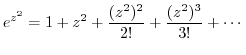
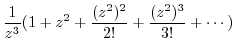
(c) For a Laurent expansion with , we have nothing to do with
. Then expand  using Taylor expansion.
 |
|
 |
|
|
 |
||
|
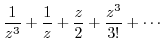 |
Note that the singularity is the 3rd pole.
(d) For a Laurent expansion with  , let
, let  . Then
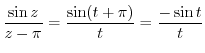 .
.
Note that we have nothing to do with
. Thus expand  using Taylor expansion.
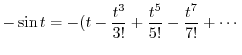
 |
|
 |
|
|
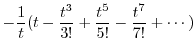 |
||
|
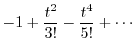 |
||
|
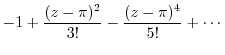 |
is removal singularity.