Next: Exercise Up: 1st Order Differential Equation Previous: Exercise Contents Index
The total differential of  is
is
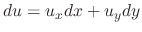
 , then we can find
  . On the other hand, if we know the total differential of a function
  , then we can determine the function .
is given by
 .
.
SOLUTION
Since
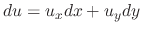 , we have

 to obtain

 is an arbitrary function of
  . Now differentiate with respect ot ,
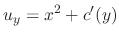
 obtained and the given above must be the same. Thus
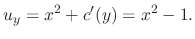
 and
and
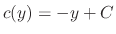 .
Therefore,
.
Therefore,

 of some function . Then the general solution is given by

 .
.
SOLUTION
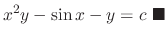
In the example above, we found the function so that is equal to the left-hand side of equation. Thus the general solution is
 and
and  be the class
  on
on
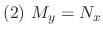
 . Then the followings are equivalent
 is exact
Proof

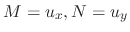
If the differential equation is exact, then there exists satisying
 . Thus we have
 with respect to and partially differentiate
  with respect to . Then
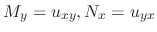
 are continuous,
 are also continuous.Thus by Schwarz lemma,
 and
and
 .
.

 be a point in the domain of
  . Consider

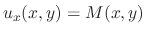 . Since
  ,
,
 |
 |
 |
|
|
 |

 is exact differential equation.

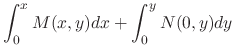
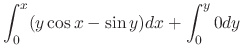
In the proof above, the general solution of is given.


SOLUTION


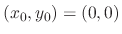 to have
 |
|
 |
|
|
 |
||
|
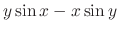 |


SOLUTION
Note that
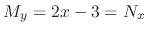 ,
,
|
|
|
|
|
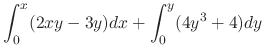 |
||
|
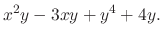 |
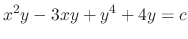
 , we have
Instead of using the formula
 , we introduce a simpler method called grouping method.
 .
.
SOLUTION
Note that
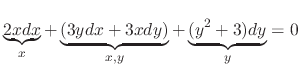
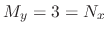 . Thus it is exact. Now we write
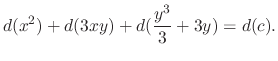
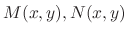 as
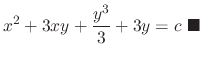
as