


Next: Exercise Up: Power series solution of Previous: Power series solution of Contents Index
Let
 be a sequence of functions defined on the interval
  . Then consider the partial sums

 for all
  in , then we say
 converges and
  is called the sum of the series .
For all in , there exists
is called the sum of the series .
For all in , there exists  such that
 implies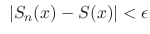
 is called uniformly convergent.
Let
 . Then the uniform convergence of the series is expressed as follows:
For each in the interval , there exists a number such that
. Then the uniform convergence of the series is expressed as follows:
For each in the interval , there exists a number such that
 .
.
in some interval , there exists a sequence of real functions  satisfying the followings

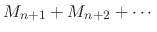
 converges uniformly and absolutely on .
Proof
 |
 |
 |
|
 |
 |
 , for all
 , there exists such that
  implies
 is indepedent of , for
  ,
,


 is continuous on the interval and
converges uniformly on , then
is continuous on the interval and
converges uniformly on , then
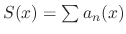 is continuous on .
is continuous on the interval and
is uniformly convergent on , then
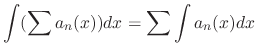
is continuous on the interval and
is uniformly convergent on , then

If
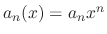 , then the series
 is called a power series. For example,
 |
|||
 |
|||
 |
|||
 |
Given
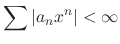
 , by the ratio test, if
 converges. Thus,
if
converges. Thus,
if
 , then
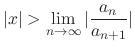 , then
 is divergent. Then the limit
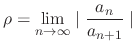
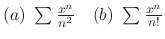
SOLUTION

 be the radius of convergence of
 . Suppose that
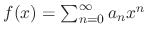 . Then
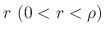 ,
,
 converges uniformly on
  .
.
 is the class
 on
on
 .
is continuous on
.
is term-by-term differentiable on
and
.
is continuous on
.
is term-by-term differentiable on
and
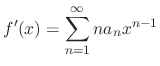 is term-by-term integrable on
and
is term-by-term integrable on
and
 on
is the same as the power series
. Thus,
on
is the same as the power series
. Thus,
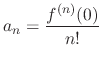
If is expressed as the power series of the positive radius
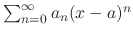 , then is called analytic at
  .
.