


Next: Exercise Up: Linear Differential Equations Previous: Exercise Contents Index

 and
and  be the fundamental solution of
  .
Let the particular solution be as follows
.
Let the particular solution be as follows

 and
and  are undeterminded functions. To find and , we need two conditions.
The first condition is that
are undeterminded functions. To find and , we need two conditions.
The first condition is that
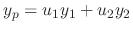 is a solution of
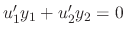
 . The second condition is to make the calculation simple, that is,
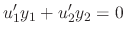
 and substitute into
. Then
and substitute into
. Then

 ,
,


 . Then

 and are solutons of . Thus the coefficients of
  and
and  are 0. Therefore,
 and
are solutions of the following system of equation.
and
are solutions of the following system of equation.
 |
 |
0 | |
 |
|
 |
 and
and  and then find
  and
and  .
.
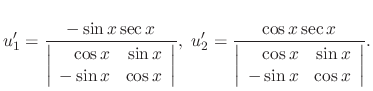
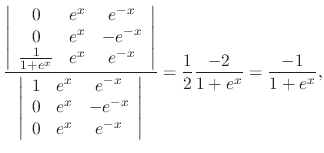
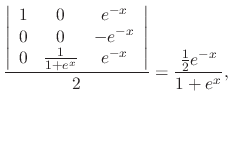
To solve the above system, we use the Cramer's rule. Then
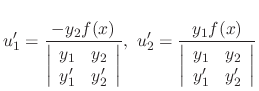 and . Since and are linearly independent. Thus by the theorem 2.5, the Wronskian is never 0. Thus we can find
and
and . Since and are linearly independent. Thus by the theorem 2.5, the Wronskian is never 0. Thus we can find
and
 . By integrating with respect to
  , we can find and . Thus we can find
.
, we can find and . Thus we can find
.
 .
.
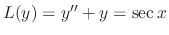
SOLUTION
The characteristic equation of is
 and thus the roots are
  . Then the complementary solution is

 . Since
 is not a solution of a homogeneous linear differential equation, we can not use the method of undetermined coefficients. So, we let

 , we have


Suppose that

 be the solution of
.
Now replace the constants
be the solution of
.
Now replace the constants
 by the variables
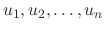 . Then

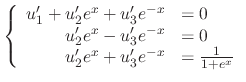
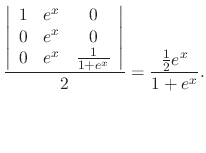
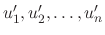 satisfy the following system.
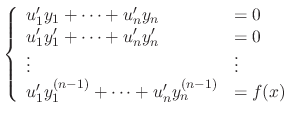
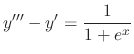
SOLUTION
The characteristic equation of
 is
is
 . Then roots are
 . Thus the complementary solution is
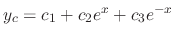
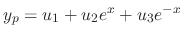
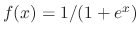 , we use the variation of parameter to find the particular solution. Let
 |
|
 |
|
 |
|
 |
|
 |
|
 |
 |
|
 |
|
 |
|
 |
|
 |
|
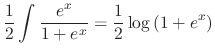 |
and we have the general solution
