


Next: Exercise Up: 1st Order Differential Equation Previous: Exercise Contents Index
In mathematics, a differential equation of the form
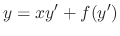
 , yielding

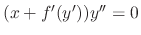 . Thus, either
  or
or
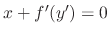 .
In the former case,
.
In the former case,  for some constant. Substituting this into the Clairaut's equation, we have the family of straight line functions given by
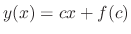 . The latter case
. We let
. The latter case
. We let
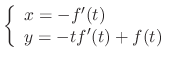 , where
  is a parameter. Then
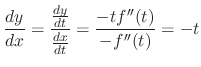
 . Then this is a solution to the Clairaut's equation. If
 has a solution
  , then
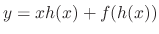 and a singular solution to
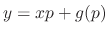 .
.
A differntial equation of the form
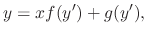
 and
and  are function of
  ,
is called D'Alembert equation.
To solve the D'Alembert's equation, we differentiate with respect to .
,
is called D'Alembert equation.
To solve the D'Alembert's equation, we differentiate with respect to .


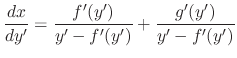 and independent variable in
  .
.
We use the following symbol for simplicity.

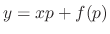
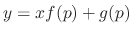

 . By factorization, we obtain
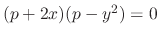 . This equation is satisfied by either
 or
or
 . Note that the general solution of is
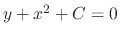 . Also,
is separable differential equation. Thus we obtaine the general solution
. Also,
is separable differential equation. Thus we obtaine the general solution
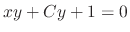 . Form this the general solution is

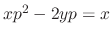 .. Then by the quadratic formula, we have
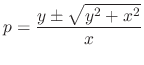
 , this is homogeneous. Let
  . Then
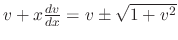 . Thus
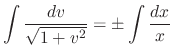

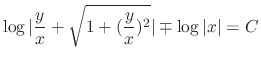
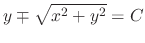

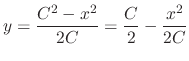
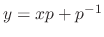 , where
  .
.

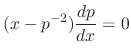
 or
or
 .
For the first case, we have
.
For the first case, we have  a some constant. Thus

 , we have
 . Thus
 into the original equation. Then
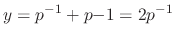


 , we have
  . Therefore, the singular solution is

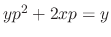 .. Then
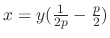 . Now differentiate with respect to , Then
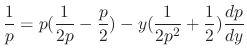
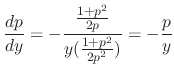
 . Then
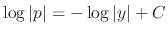 ,
,  . From this, we have
. Delete and we have the general solution
. From this, we have
. Delete and we have the general solution
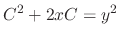
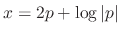 ..
..
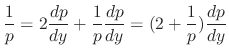
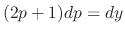
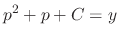 as a parameter,
