Next: Triple Integrala Up: Application of Double Integrals Previous: Surface Area Contents Index
Given a closed bounded region  and continuous functions
 on , and suppose that
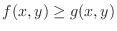 on . Then the volume of solid bounded by the lines parallel to
  -axis through the boundary
 and the surfaces
  is given by
![$\displaystyle V = \iint_{\Omega}[f(x,y) - g(x,y)]dxdy $](img1486.png)
 .
. -plane is
 and
and  . Thus,
 . Also
 implies
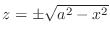 . Thus the upper surface is
 and the lower surface is
over . From this, the volume of the solid is set up by
and the lower surface is
over . From this, the volume of the solid is set up by
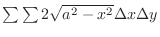 , where
 represents the small rectangle of base area and
 represents the height of a small solid cylinder.
Now use vertically simple region for . Then
represents the height of a small solid cylinder.
Now use vertically simple region for . Then

 |
 |
 |
|
|
 |
||
|
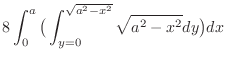
![$\displaystyle 8\int_{0}^{a}\big[\sqrt{a^2 - x^2}y\big]_0^{\sqrt{a^2 - x^2}}dx$](img1500.png) |
||
|
![$\displaystyle 8\int_{0}^{a}(a^2 - x^2)dx = 8\left[a^2 x - \frac{x^3}{3}\right ]_{0}^{a} = \frac{16a^3}{3}
\ensuremath{ \blacksquare}$](img1501.png) |
 and
and
 .
.
SOLUTION Note that the solid is bounded by the surface goes through the boundary of
 and parallel to the -axis, and the plane
  ,
,  .
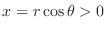
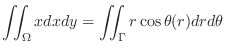
Using the polar coordinate to express . Since
.
Using the polar coordinate to express . Since
 ,
,

|
|
 |
|
|
 |
||
|
![$\displaystyle 2\left[\sin{\theta}\right]_{0}^{\frac{\pi}{2}}\left[\frac{r^3}{3}\right]_{0}^{a} = \frac{2a^3}{3}\ensuremath{ \blacksquare}$](img1515.png) |
Exercise A
(a) The region enclosed by

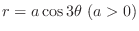
(b) Inside of the curve
 and outside of the curve
 .
.
(c) Inside of the curve
and outside of the curve

(a)
 with
with
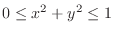 ,
,  .
.
(b)  with
with
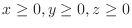 .
.
(c)  with
with
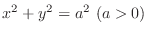 .
.
(a)
 with
with 
(b)
with

Exercise B
(a) Sphere
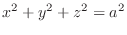 with the radius
  .
.
(b) with
(c)
 and
and
 .
.
(d) The surface generated by rotating
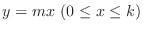 about
about  -axis for
  .
.
(a)
with
(b)
 .
.
(c)
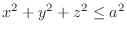 and
and
 .
.
(d)
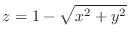 and ,
and ,  .
.