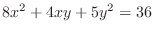
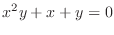
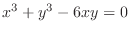
Next: Lagrange Multiplier Up: Conditional Extrema Previous: Conditional Extrema Contents Index
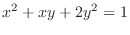
From the equation
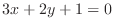 , we can find
  in terms of
  . In other words, we can find
 . In general, given a quadratic function
  , if
, if  always satisfies
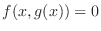 , then we say the equation is an implicit function determined by the equation
 .
.
is the class  at
at
 in the region
  . If
. If
 determined by
in the neighborhood of
determined by
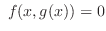
in the neighborhood of  which satisfies
 |
 |
||
 |
 |
||
 |
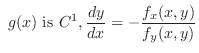 |
NOTE In the neighborhood of the point satisfying
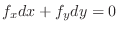
 , the implicit function exists and the implcit function is differentiable. Thus the total diffetential of
  is
is
 ,
,
 , we have
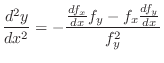
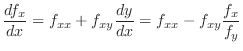
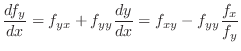
 |
 |
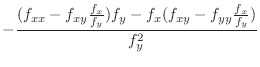 |
|
|
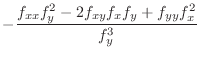 |
such as
 deteremined by
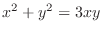
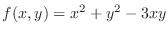 and take total differential of ,

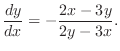
 ,
,
 |
|
 |
|
|
 |
such as
deteremined by
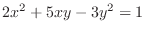
 and find total differential of . Then

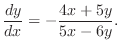
 |
|
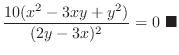
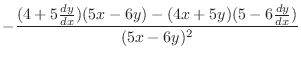 |
|
|
 |
 for the implicit function
 determined by the equation
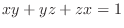 .
. , set
, set
 . Then,
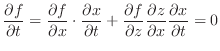
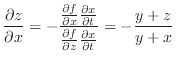
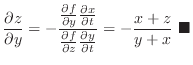
for the implicit function
determined by the equation
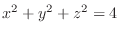 .
.
SOLUTION
For
 , set
.
, set
.
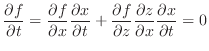
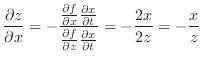
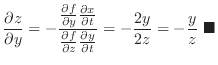
 of is determined by the equations
 , then,
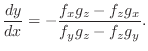
 for the implicit functions of determined by the equations
 .
.
SOLUTION
Let
 . Then totally differentiate and
  to get

 to get

Thus,
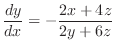
 to get

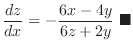
for the implicit functions of determined by the equations
 .
. . Then find total derivatives.
.
. Then find total derivatives.
.

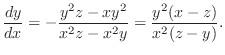 .
.


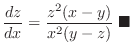
Exercise A
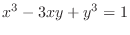
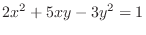
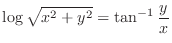
for the implicit functions of determined by the following functions.
for the implicit functions of determined by the following functions.
Exercise B
for the implicit function of determined by the following equations.
for the implicit function of determined by the following equations.
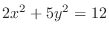 at the point
 .
.
 at the point
 .Find the equation of the normal line through
.
implicitly defined by the following equations.
.Find the equation of the normal line through
.
implicitly defined by the following equations.